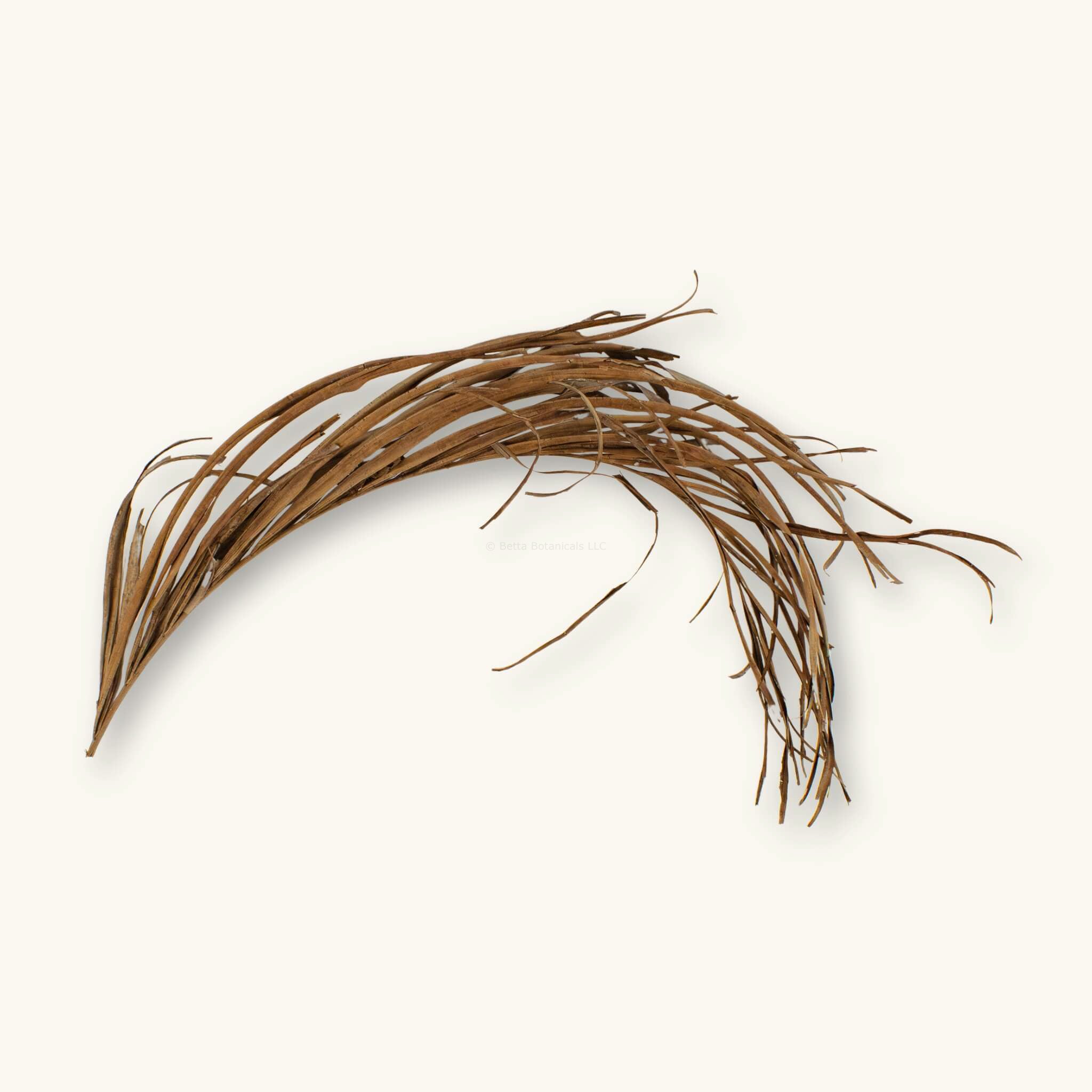
SKU: 19077730945
areca palm buffer

areca palm buffer Areca Palm Fronds for Blackwater Aquariums

Sale price$26.37 Regular price$29.30
Save 10%

Pay in installments of $7.33 with ShopPay, AfterPay and Klarna

Shipping Estimate
USA
  • USA
  • CAN

Ships within 48 hours · Estimated delivery Nov 3 - Nov 8

Promo Codes Available:

For Your Every Summer RSVP, with Code: SUMMER15

Description

areca palm buffer Areca Palm Fronds for Blackwater AquariumsAreca Palm Fronds on the Surface: The Areca Palm Fronds that we use in aquariums come from Dypsis lutescens, a palm native to Madagascar that's been widely naturalized across warm climates. They have rather long, medium durability, feather like fronds, though some may condition quickly in ecosystems containing plecos and other rasping or nibbling fishes. They will often float at first, creating immediate cover for fish and shrimp in botanical method,

Areca Palm Fronds on the Surface:

The Areca Palm Fronds that we use in aquariums come from Dypsis lutescens, a palm native to Madagascar that's been widely naturalized across warm climates. They have rather long, medium-durability, feather-like fronds, though some may condition quickly in ecosystems containing plecos and other rasping or nibbling fishes. They will often float at first, creating immediate cover for fish and shrimp in botanical method, blackwater, and biotope aquariums, and bioactive enclosures. Their widespread naturalization allows them to function as a broadly compatible, “generic tropical” botanical across many methods of aquarium keeping, and their low tannin content makes them ideal for the habitat replication of both clear water and blackwater streams.

Essential Details

  • Tannin Level: Low
  • Tint Color: Minimal to light tea brown
  • Durability: Slow to decompose; leaflets soften gradually and hold structure for extended use
  • Habitat Location: Native to Madagascar, widely naturalized in tropical and subtropical regions
  • Optimal For: Bettas, gouramis, tetras, rasboras, shrimp, snails, nano fish, community tanks, and bioactive enclosures for snakes, geckos, frogs, isopods, and springtails
  • Use with Caution: Suitable for all inhabitants
  • Size Range: Typically 15–20 inches long, with natural variation in leaflet spacing and thickness
  • Quantities: Sold as 1 count Areca Palm Frond or 3 count Areca Palm Fronds

Areca Palm Fronds for Aquariums & Vivariums

Areca Palm Fronds just look tropical! The long leaflets create soft line-of-sight breaks that fish use immediately, especially small schooling fish and timid species that settle faster when they can weave in and out of cover. They are a favorite amongst angelfish enthusiasts, or with nano fish like the green neon tetra.

Functionally, fronds provide a lot of surface area that is quick to be colonized with bacterial films and fungi, which then become grazing surfaces for shrimp and snails. In the botanical method aquarium, this forms the basis of the food web and is a level of the food chain that standard aquariums are often missing.

Once broken down, the frond fragments help in the mulm accumulation and substrate formation between larger leaves and seed pods. This natural substrate formation is exactly what we see in nature, especially when the frond is laid over leaf litter or tucked against wood. In this perpetual substrate approach, the mulm layer is a food source, as it feeds beneficial microbes and supports slow nutrient cycling within the litter layer for aquatic plants.

In nano aquariums, one frond can provide the entire habitat and cover on its own. In larger aquariums, using multiple fronds creates a broader “canopy” effect across the substrate, which fish and invertebrates utilize as habitat.

In bioactive enclosures, Areca Palm Fronds help replicate the diversity of litter found on the forest floor. They trap pockets of humidity in the litter, and create pathways that isopods and springtails use for refuge and feeding as microbial films develop. For reptiles and amphibians, this can increase activity because the enclosure offers more usable cover and more microclimates within the same footprint.

Beneath the Leaves: Dypsis lutescens in the Wild

Historically, palm fronds have been used as symbols of triumph, victory, and renewal, appearing in religious, ceremonial, and civic traditions across the Mediterranean, Africa, and parts of Asia. This association reflects the palm’s resilience and its ability to persist and regenerate in demanding environments.

Palms as a group have long provided practical resources as well. While Dypsis lutescens itself is not a major food crop, many closely related palm species produce edible fruits, sap, or starches that have supported human communities for thousands of years. The shedding of fronds and fruits links canopy growth to the ground below, reinforcing the constant exchange between living plants and the detrital systems that follow.

Sustainability Note:

This product’s packaging is home compostable. Just like the botanicals inside, it will break down naturally and return to the soil—because what supports your ecosystem should minimally impact our planet.

Not for human consumption. Preparation required.

This is a natural product—variation in color, shape, and texture is expected.

Shipping Notes
  • Free Standard Shipping on $100+ Orders to the USA.
  • Except Preorder products are shipped in 48 hours.
  • Delivery to the USA:
  1. Standard Shipping : 3-10 business days
  • If time is of the essence, please consider selecting expedited delivery for faster service.
Exchange/Return Notes
  • We offer a 30-day return/exchange service after receiving.
  • Final sale items are not eligible for returns or exchanges.
  • To process your return/exchange, please contact us at [email protected]
  • Please click here for more details>>> Return & Exchange Policy
SKU: 19077730945

Discover Niche Categories That Outsell areca palm buffer

Top-Converting Item to Boost Your Average Order

4.3 ★★★★★
Based on 21 reviews
Sort
Highest Rating
Newest First
Oldest First
Product Reviews
A
Verified Purchase
Allen G.
Fort Morgan, US
★★★★★ 5
Good choice to teach kids to be well-mannered at Memorial Day.
Format: Hardcover
The book starts with the 13 colonies each with their own flag. Then it discusses the Revolutionary war and the story of Betsy Ross with the qualifier that It says no one really knows who sewed the first flag. Then it discusses Francis Scott Key and the bombardment of Fort McHenry. Then how a star is added for each state added to the union. Mentions the Civil War and raising the flag on Iwo Jima. After that it has two pages on protocol for displaying and honoring the flag, and gives the pledge of allegiance. It is a good choice to teach kids to be well-mannered at parades and Memorial Day services. The cover art depicts a series of historical flags, not all of which are mentioned in the book which raises the question “Why?”. Starting at the back is the red Saint George’s Cross on a white field. Saint George the dragon slayer is the patron saint of England. The plain cross without the centered crown is the flag of England. This flag is shown on page 2 as the flag of one of the colonies but it doesn’t say which. In front of that is the flag of Maryland Colony which is still used as their state flag. Next in line is the coiled rattle snake Don’t Tread on Me flag. According to my Compton’s Encyclopedia, this originated with Esek Hopkins the first US Navy commander in chief and was used from 1776 to 1778. Colonel Christopher Gadsden presented a copy of this flag to the South Carolina legislature, so it is often referred to as the Gadsden flag but this is incorrect. The rattle snake image was used in 1775 by the minute men of Culpepper County Virginia. The image was widespread in the revolution and may have been used earlier than that. The snake is portrayed with 13 rattles, one for each colony. Rattle snakes will not initiate an attack on humans as we are too big to eat, but if stepped on they will counter attack and can be deadly. The point of the image is that the colonists did not want war, but would not tolerate abuse. (There is a rumor that this flag is connected to the slave trade, but Hopkins was from Rhode Island which was not part of the Confederacy, and I have not found any evidence to support this rumor). Next is the flag of New England which has the Saint George cross with a Pine Tree on a blue field. This flag was used at the battle of Bunker Hill. Normally the New England flag has a red field, but blue was substituted because the red caused confusion with the British Royal Navy ensign which has a Union Jack in the top left on a red field. Naval ensigns are designed to be highly visible at distance or in the smoke of battle. The bright red field is more visible than the Union Jack alone. The Union Jack is the national flag of the United Kingdom. Next is the Union Jack on a field of thirteen stripes. This is the first flag of the thirteen colonies. It was used in 1775 and 1776 as the flag of the continental army and navy but never officially adopted. Next is the Betsy Ross flag, followed by the Fort McHenry flag, and the modern flag. I hope this helps.
WAS THIS REVIEW HELPFUL?YesReportShare
Reviewed in the United States on September 4, 2023
S
Verified Purchase
SweetT
Louisville, US
★★★★★ 5
No progressive agenda! Perfect kids book!
Format: Hardcover
I'm a homeschooling parent of a kindergartener. As part of our social studies curriculum, I have been introducing the Pledge of Allegiance and the anthem, and I wanted to find a book that would go a little further into how the flag came to be and why we stand to say the Pledge, and this was the perfect book! It's written with great accuracy and at a child's level. There is also no progressive agenda, as I had discovered with some of the other kids books on the subject. It also lists when and how you are to stand for the flag, and has the Pledge printed in it. Would definitely recommend!
WAS THIS REVIEW HELPFUL?YesReportShare
Reviewed in the United States on September 27, 2025
M
Verified Purchase
Michele
San Leandro, US
★★★★★ 5
Very patriotic and educational
Format: Hardcover
I love everything about this book for my flag crazy grandson! He loves learning about our American flag. Very patriotic book. He's a bit young (not yet 3 years old) to fully understand it. But it's amazing what he picks up from having it read to him (over and over and over again!) He loves to sit and look at the pictures early in the morning before the rest of us are up and awake.
WAS THIS REVIEW HELPFUL?YesReportShare
Reviewed in the United States on April 18, 2025
U
Verified Purchase
Ulrike HD
Boise, US
★★★★★ 5
Great to teach with
Format: Hardcover
Respect for the flag is very important to me. I had volunteered to present flag etiquette to 5th grade social studies class. After the presentation, I realized I need to find something easier for them to comprehend. Purchased to help me share with younger students.
WAS THIS REVIEW HELPFUL?YesReportShare
Reviewed in the United States on December 11, 2025
B
Verified Purchase
Bobby
Whiting, US
★★★★★ 5
Perfect book!
Format: Hardcover
Great book! I used it for a co-op lesson about the flag and kids ages 5-11 enjoyed it. Good history, I liked that they cover the proper ways to respect a flag at the end.
WAS THIS REVIEW HELPFUL?YesReportShare
Reviewed in the United States on May 28, 2025

recommand products