
Pay in installments of $7.48 with
 ,
 and

Shipping Estimate
USA
- USA
- CAN
- USA
- CAN
Ships within 48 hours · Estimated delivery Nov 14 - Nov 19
 Promo Codes Available:
For Your Every Summer RSVP, with Code: SUMMER15
Description
wildflower farm's eco-lawn grass seed Wildflower Farm's Eco-Lawn 50 lb Grass Seed CoverageEco Lawn is a drought resistant grass that requires mowing only once per month. Each 50 pound bag of seed covers 10,000 square feet. Eco Lawn 5 lbs bags available here. Read more Overview Wildflower farm's eco lawn grass seed is a blend of carefully selected fine fescue grasses developed by Wildflower Farm. Eco Lawn grows in full sun, part shade and even deep shade. Eco Lawn is highly drought tolerant once established, and has a rich dark green color.
Eco-Lawn is a drought-resistant grass that requires mowing only once per month. Each 50 pound bag of seed covers 10,000 square feet.
Eco-Lawn 5 lbs bags available here.
Overview
Wildflower farm's eco lawn grass seed is a blend of carefully selected fine fescue grasses developed by Wildflower Farm. Eco-Lawn grows in full sun, part shade and even deep shade. Eco-Lawn is highly drought tolerant once established, and has a rich dark green color. Eco-Lawn does not require fertilizing and can be mown like a regular lawn or left unmown for a free-flowing carpet effect.
Experience what thousands of people across North America already know about Eco-Lawn!
Features & Benefits:
- Environmentally friendly
- Organic lawn grass seed
- 50 lb grass seed coverage
- Drought Tolerant
- No fertilizers or chemicals required
- Less vulnerable to insects and grubs
- Reduce your mowing time or don't mow at all!
When is the best time to plant Eco-Lawn?
Click here for the Eco-Lawn Seeding Time Chart.
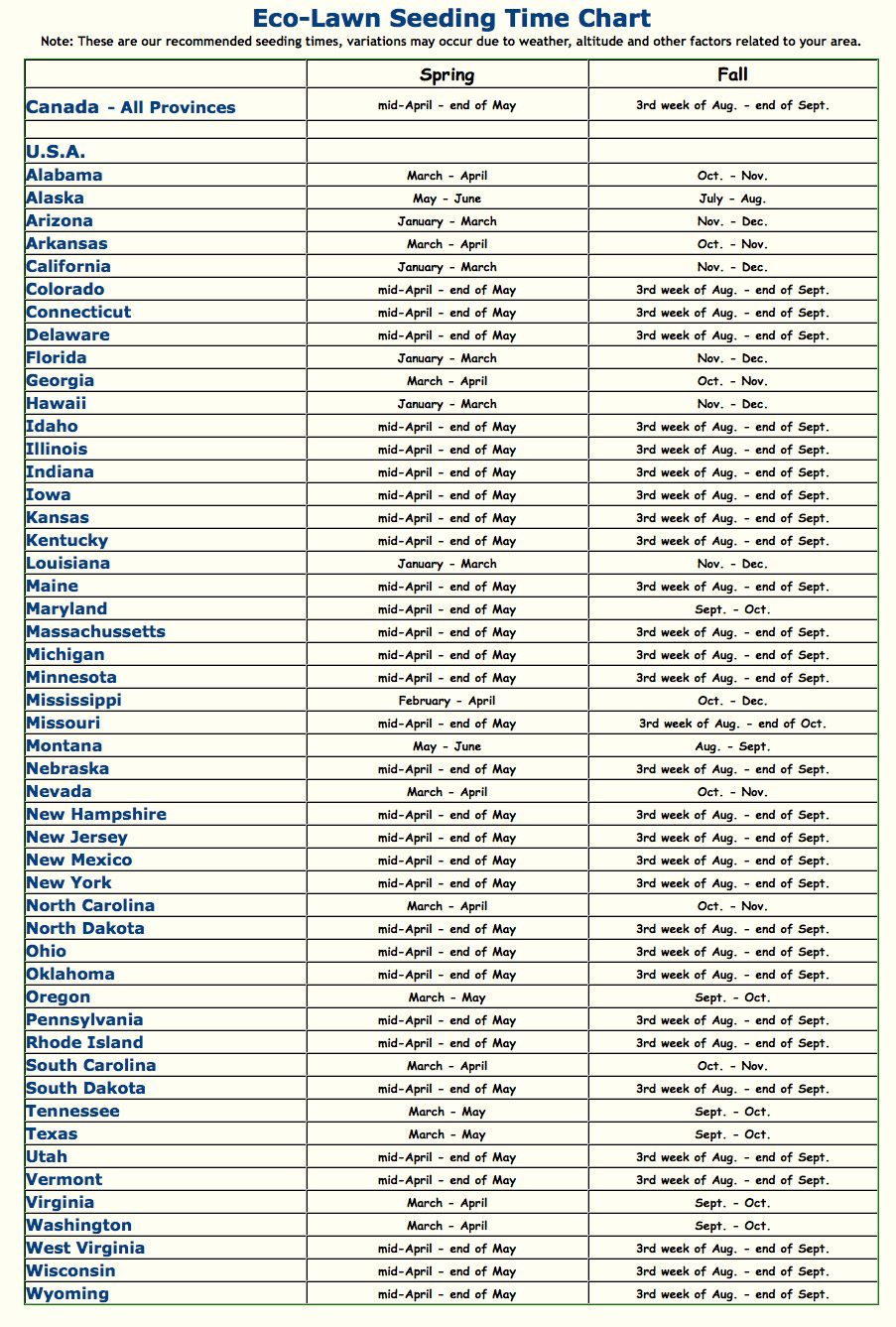
Like most grass seed, Eco-Lawn germinates best in cool, moist conditions (approximately 65° F or 18° C). For most of North America, the best time to sow Eco-Lawn is in early autumn or early spring. In California and other warm climates, November – March is the ideal time to sow Eco-Lawn as this gives the turf time to establish before the heat of summer. For the best seeding time in your specific area, please refer to our Seeding Times Chart.
Using Eco-Lawn:
Establishing a New Eco-Lawn
Proper soil preparation is the key to success and is the best opportunity to create a beautiful lawn that will last a lifetime. Taking shortcuts on site preparation will often come back to haunt you with chronic lawn problems such as thatch, weeds and disease.
- Eliminate all weeds existing on the site.
- Remove all debris from the area to be seeded. Do not bury construction debris as this will cause problems later on.
- Rototill the site to loosen the soil to a depth of 3 inches.
- Ensure that there is a gentle grade sloping away from any buildings. Grades are very important as too steep a grade can cause erosion and loss of nutrients. A grade of one to two percent away from buildings is ideal (one to two feet per one hundred feet of land). Poor drainage can result in a water-logged lawn.
- Rake the area to smooth the surface and create a good seed bed.
- Spread a small amount of weed free, organic compost, a 1/4 inch layer equals 3/4 cu. yard for every 1,000 sq. ft. This will help to start the seeds and the compost will fertilize your lawn for a year. This also helps keep out future weeds and grubs.
Converting Existing Lawns to an Eco-Lawn
1) Apply an organic herbicide to your old lawn. Organic herbicides may not kill plants with just one application. You will have to spray your old lawn every two weeks for up to eight weeks. Read the label carefully. Once your old lawn is dead, mow the dead grass as short as possible and then roughen the area by hard raking it. Then seed the area with Eco-Lawn.
2) Alternatively, strip off the old lawn to a depth of 2 1/2 - 3 inches and remove it entirely. Then either lightly rototill the existing soil or give it a hard raking to create a seed bed. Then spread the seed, rake it into the soil and if possible, roll it flat with a lawn roller.
3) Another method is smother your existing lawn with 4 inches of new soil. This will kill off the old lawn underneath and you can simply spread your Eco-Lawn seed onto the new soil, rake it in and roll it.
Overseeding Existing Lawns
Simply overseeding an existing lawn with Eco-Lawn will not result in an instant conversion to a low maintenance Eco-Lawn as your existing lawn will continue to grow. However, if you were to overseed your old lawn each and every year for four to five years, it will become a true Eco-Lawn. In the meantime, you will need to regularly mow the existing lawn. So while this method will work, it does take time, patience and annual re-seeding. You can accelerate the conversion process by overseeding twice in a year.
Seed Installation
Spread Eco-Lawn seed at 15 seeds per square inch (5 lb covers 1,000 square feet) or spread the seed extra thick at 25 seeds per square inch or 7-8 pounds per 1,000 square feet. For small areas you may sow by hand. For urban or suburban-sized lawns, use a fertilizer spreader set at about 1/3 open and apply the seed in two passes using half the Eco-Lawn seed per pass - one at right angles to the other in a crisscross pattern for complete coverage.
Gently rake the wildflower grass seed into soil until just slightly covered, you should see some seed on the surface after raking.
Roll the area with an empty to 1/4-full lawn roller (do not fill the roller more than 1/4-full with water so that you do not compact soil). Rolling seeds in for good soil contact is especially important if you have any kind of slope to prevent erosion.
For large areas, Eco-Lawn may be installed via mechanical seeders or hydro-seeding.
Sowing Eco-Lawn Under Large Trees:
While Eco Lawn grass seed will germinate and grow under large trees, please remember that trees need and take a lot of water, so for the first full growing season, please continue to water your Eco-Lawn deeply under the "drip line" of the trees on a weekly basis. This will encourage the deep roots that Eco-Lawn develops to dig down deep. By next year, you should not need to water under the trees at all as your Eco-Lawn will be able to compete with the trees for the water that nature provides. Leaves from trees should be removed in the fall. Mowing them with a mulching mower is the easiest method. The nutrients from the mulched leaves are all the fertilizer your Eco-Lawn should need.
Sowing Eco-Lawn on Slopes:
On steep, erosion-prone slopes Eco-Lawn should be mixed with with an annual rye grass for rapid soil stabilization. Add 1/2 lb annual ryegrass for every 1 pound of Eco-Lawn seed. When planting on slopes in the fall, plant no later than mid-September in northern climates to ensure sufficient growth of the nurse crop to hold the soil. On gentle slopes with no soil erosion, seeding with Eco-Lawn alone is fine.
Dormant Fall Seedings:
In northern climates seeding Eco-Lawn in late season (dormant seeding) can be done very successfully. Careful soil preparation, weed control and good timing are essential with dormant fall plantings. The seeds should be planted in the late fall or early winter after a couple of hard frosts but before the ground is frozen. Seed planted in late October through December will germinate early the following spring. If there is any chance of erosion, a dormant seeding is not recommended. Planted in fall, your new lawn will grow rapidly the following spring.
After Sowing Eco-Lawn
Eco-Lawn germinates in 7-14 days. It is quick to germinate and then slow to grow. During the first few weeks, keep as much traffic off the seedbed as possible. The tender, emerging shoots of your Eco-Lawn will not withstand much wear and tear. Once the grass has grown up to 4-5 inches, you can begin cutting it if you choose to do so. This should be after about 4-6 weeks of growth. If you have some patches that aren't as thick as the rest, they may not have received enough seed. Don't be afraid to overseed these areas. The longer they stay bare, the more likely weeds will encroach onto your lawn.
After seeding, water every day (if it does not rain) for 3 weeks in the early morning for 20-30 minutes or what ever length of time it takes to be moist down to one inch. Set up an automatic timer if you cannot water regularly yourself. Adjust the watering so that your soil will stay moist but not have puddles over night.
Please note that if you experience drought conditions in the first year, you will need to water your new Eco-Lawn during the first season of growth. Once Eco-Lawn has gone through a full season, your watering regime will change dramatically. In hot, dry climates such as parts of California or Texas your watering will be cut back by 75% over that of traditional, shallow rooted turfs. In most parts of North America your established Eco-Lawn will require no watering except in extreme drought conditions.
Mowing Eco-Lawn
The reason you don't need to mow Eco-Lawn often is because it grows slowly. If you prefer a traditional "cropped lawn look," occasional mowing will be necessary, but far less frequently than with other lawn mixtures. Ensure that your mower has sharp blades to prevent damage to the grass. A mulching mower works best. Set your mower to a minimum 3 inch height. Mowing lower than 3 inches will cause damage to your Eco-Lawn as it, like all plants, needs to go through the process of photosynthesis in order to live. Never remove more than one third of the top growth. Mowing too short will damage the turf and reduce its vigor. One of the most common lawn problems is people mowing their lawns too short! Left unmown, your Eco-Lawn turfgrass will form a gentle, flowing carpet of grass.
Maintaining your Eco-Lawn:
Once your Eco-Lawn is established, you'll only need to water it during extremely dry periods, if at all. If you feel that you do need to water it, occasional thorough soakings are better than frequent light sprinklings This encourages deep root growth, and makes your turf more drought-tolerant. Fertilizer should be applied sparingly, if at all, in early spring or late summer only. Slow-release, balanced fertilizers with nearly equal portions of nitrogen, phosphorus and potassium are best. This encourages strong root development to keep your turf healthy without excessive top growth that requires mowing. With minimal fertilizing and watering, you'll reap the benefits of reduced maintenance, lower costs and a healthier environment!
A thick healthy lawn is the best defence against weeds, disease, drought and insect damage. Overseeding your Eco-Lawn on a yearly basis will foster new growth and keep your Eco-Lawn thick and healthy.
Question: How many gallons of water a year will I need to water my Eco-lawn compared to traditional lawn seed such as Kentucky bluegrass?
Answer: Eco-Lawn requires minimal watering. In southern California, for example, no more than 12,400 gallons of water is necessary for a 1,000 square foot Eco-Lawn for the whole year. A standard Kentucky bluegrass or perennial rye lawn requires 1-2 inches of water a week. For a 1,000 sq. ft. lawn that amounts to more than 100,000 gallons a year.
What is in Eco-Lawn?
Eco-Lawn is comprised of the following certified fine fescue grasses:
SR5250 Creeping Red Fescue, SR5130 Chewings Fescue, SR3150 Hard Fescue, Shoreline Slender Creeping Red Fescue, Quatro Sheep Fescue, SR3210 Blue Fescue.
None of the species in Eco-Lawn are genetically modified (GMO).
Read our article Fall is the Best Time to Plant Your Eco-Lawn for a comprehensive guide on growing Eco-Lawn.
Shipping Notes
- Free Standard Shipping on $100+ Orders to the USA.
- Except Preorder products are shipped in 48 hours.
- Delivery to the USA:
- Standard Shipping : 3-10 business days
- If time is of the essence, please consider selecting expedited delivery for faster service.
Exchange/Return Notes
- We offer a 30-day return/exchange service after receiving.
- Final sale items are not eligible for returns or exchanges.
- To process your return/exchange, please contact us at [email protected]
- Please click here for more details>>> Return & Exchange Policy