SKU: 38526414330
air plants homebase

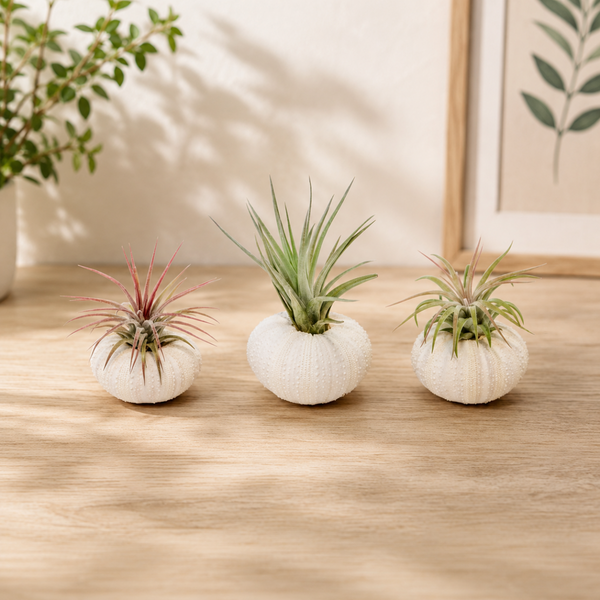
air plants homebase White Urchin with Tillandsia Air Plant, No Soil Needed, Easy Care

Sale price$20.12 Regular price$22.35
Save 10%

Pay in installments of $5.59 with ShopPay, AfterPay and Klarna

Shipping Estimate
USA
  • USA
  • CAN

Ships within 48 hours · Estimated delivery Nov 2 - Nov 7

Promo Codes Available:

For Your Every Summer RSVP, with Code: SUMMER15

Description

air plants homebase White Urchin with Tillandsia Air Plant, No Soil Needed, Easy CareDescription Light Soil Water Hardiness The White Urchin with Tillandsia Air Plant is a creative pairing of a natural sea urchin shell and a living Tillandsia, a genus of epiphytic plants in the bromeliad family native to Central and South America and the southern United States. Tillandsias are commonly called air plants because they require no soil to grow, drawing moisture and nutrients directly from the air around them. This combination turns an

  • The White Urchin with Tillandsia Air Plant is a creative pairing of a natural sea urchin shell and a living Tillandsia, a genus of epiphytic plants in the bromeliad family native to Central and South America and the southern United States. Tillandsias are commonly called air plants because they require no soil to grow, drawing moisture and nutrients directly from the air around them. This combination turns an organic coastal keepsake into a miniature living display.

    The white sea urchin shell serves as a natural vessel, its rounded, textured form contrasting beautifully with the soft, arching green to silvery-green leaves of the Tillandsia nestled inside. The spiky, rosette-shaped air plant typically stays compact, reaching just a few inches in width, making it ideal for small shelves, windowsills, terrariums, or as a standalone accent piece on a desk or tabletop.

    This arrangement makes a charming gift and fits effortlessly into coastal, bohemian, or minimalist home decor. Because it needs no soil or pot, it is wonderfully versatile and easy to move around the home. This plant is best placed away from curious cats and dogs, and kept out of reach of young children to protect the delicate shell and plant.
  • Tillandsia air plants thrive in bright, indirect light. Place yours near a sunny window where it receives several hours of filtered light each day. Avoid prolonged direct afternoon sun, which can scorch the delicate leaves. Fluorescent or full-spectrum grow lights also work well if natural light is limited in your space.

    Water by misting the leaves thoroughly two to three times per week, or by gently removing the plant from the shell and soaking it in room-temperature water for 20 to 30 minutes once a week. After soaking, shake off any excess water and allow the plant to dry completely within four hours before returning it to the shell. Standing water trapped in the base of the leaves can cause rot, so good airflow after watering is essential.

    No soil is needed for Tillandsia air plants. They absorb water and nutrients through tiny structures on their leaves called trichomes. The sea urchin shell simply acts as a decorative holder. If you ever want to display the plant differently, it can rest on any clean, dry surface or be placed in a terrarium, on driftwood, or mounted with safe adhesive.

    Tillandsias prefer temperatures between 50 and 90 degrees Fahrenheit (10 to 32 degrees Celsius). They appreciate good air circulation, so avoid placing them in sealed containers or stuffy corners. Keep them away from heating or air conditioning vents, which create dry, harsh airflow that can stress the plant. Normal household humidity levels are generally sufficient, though occasional misting helps in drier climates.

    Feed your Tillandsia once a month using a bromeliad or air plant fertilizer diluted to one quarter of the recommended strength. Apply it by misting the leaves directly with the diluted solution. Fertilizing is optional but encourages healthier growth and can prompt the plant to produce its colorful bloom when it reaches maturity.
  • USDA Hardiness Zones 9-11 | Minimum temperature: 25°F (-4°C)

    In zones 9 through 11, Tillandsia air plants can be displayed outdoors in a sheltered spot with bright, filtered light and good airflow during warm months. Bring them indoors when temperatures drop below 50 degrees Fahrenheit (10 degrees Celsius), as they are sensitive to cold and cannot tolerate frost. In cooler zones, they are best grown year-round as indoor plants near a bright window.

Shipping Notes
  • Free Standard Shipping on $100+ Orders to the USA.
  • Except Preorder products are shipped in 48 hours.
  • Delivery to the USA:
  1. Standard Shipping : 3-10 business days
  • If time is of the essence, please consider selecting expedited delivery for faster service.
Exchange/Return Notes
  • We offer a 30-day return/exchange service after receiving.
  • Final sale items are not eligible for returns or exchanges.
  • To process your return/exchange, please contact us at [email protected]
  • Please click here for more details>>> Return & Exchange Policy
SKU: 38526414330

Discover Niche Categories That Outsell air plants homebase

Top-Converting Item to Boost Your Average Order

4.5 ★★★★★
Based on 24 reviews
Sort
Highest Rating
Newest First
Oldest First
Product Reviews
T
Verified Purchase
Timothy M.
West Palm Beach, US
★★★★★ 4
Nice shelves that will work with some modifications
Item Package Quantity: 1, Size: 6 Tiers, Item Package Quantity: 1, Size: 6 Tiers
Pay attention to the bottom shelf and where it is relative to the floor. It’s only about 6 inches, which isn’t good for a retail environment. I swapped the bottom nipples out for some 10” nipples and the results were night and day. So much better now.
WAS THIS REVIEW HELPFUL?YesReportShare
Reviewed in the United States on April 25, 2026
N
Verified Purchase
Nursewendy
Alexandria, US
★★★★★ 5
Very nice!!!
Item Package Quantity: 1, Size: 6 Tiers, Item Package Quantity: 1, Size: 6 Tiers
The perfect addition for our hunting closet! Provides nice storage for decoys and baskets, went together easily and installed quickly. Love the look, sturdiness and function.
WAS THIS REVIEW HELPFUL?YesReportShare
Reviewed in the United States on August 24, 2025
A
Verified Purchase
Adam
Natrona Heights, US
★★★★★ 5
Cool design and good customer service
Item Package Quantity: 1, Size: 4 Tiers 24 Inch, Item Package Quantity: 1, Size: 4 Tiers 24 Inch
I had a concern and the seller offered great customer service. Pleased with the look of the shelves.
WAS THIS REVIEW HELPFUL?YesReportShare
Reviewed in the United States on January 15, 2026
B
Verified Purchase
Becky J.
Natrona Heights, US
★★★★★ 5
Good shelves
Item Package Quantity: 1, Size: 6 Tiers
Unit was pretty easy to assemble. Shelves are sturdy and no scratches or dings. My only complaint is that there is paint missing here and there on the black pipe. We covered those spots with magic marker. I would buy it again!
WAS THIS REVIEW HELPFUL?YesReportShare
Reviewed in the United States on March 5, 2025
D
David Hollifield
Port Orchard, US
★★★★★ 5
An excellent collection of essays
Format: Paperback
An excellent collection of essays. A few of which deserve a brief note. As someone from within the Reformed tradition, I particularly appreciated the chapters on Calvin and the missional impulse of the Reformed branch of the Reformation (Chapters 4, 5, and 6). Karen Spiecker Stetina’s chapter on Calvin’s Geneva as a virtual mission training center to launch missionaries around Europe and elsewhere was not only enlightening but instructive. The chapter detailing the Reformed mission to Brazil (chapter 6)–while the mission itself was underwhelming in its achievements–was especially intriguing. These chapters thoroughly undue the misconception of Calvin and his followers as missionally indifferent. Turning to the Catholic portion of the essays (the book is split into two portions, one detailing Protestant mission in the 16th century, and the other, Catholic mission during that period), one will find essays dealing with spirituality surrounding missions (chapters 10 and 13), the intersection of missions and colonialism (chapters 12, 14, and 15), and the issue of accommodation in mission (chapter 11). All of which are exceptional. As someone who has spent time practicing and studying mission on the continent of Africa, I found John Thornton’s chapter on the Jesuit mission to Kongo in this section to be particularly insightful. This is partly due to the nature of the mission itself. As Thornton points out, the mission was not to evangelize but to “reform a new but vibrant Catholic Church” in Kongo (265). This chapter has much to teach contemporary mission practitioners in Subsaharan Africa as the situation is largely the same for missionaries there today: one of building up rather than evangelizing. What’s more the mission failed after only a 7 year stent. There is much here for missionaries to evangelized lands/peoples today to sit with and learn from. But perhaps the greatest benefit of the book is an expansion of an understanding of mission. Rather than viewing mission narrowly as moving to a foreign land, the essays (particularly in the Protestant section of the book), as Smither notes in the introduction, “allow Luther, Calvin, Ignatius of Loyola, Teresa of Avila, and others to define mission on their terms and through their practice” (1). One must read the book to come a full scope of how they did so; but it ranges from being light in dark places through the preaching of the true Gospel, to church planting, to the creation of training centers just to name a few (and those are just from a single chapter!). Gallagher and Smither’s Sixteenth Century Mission is an excellent contribution to the study of Christian world missions especially as it deals with an era typically thought to be devoid of what we today understand that phrase to entail. Disclaimer: I received this book for free from Lexham Press in exchange for an honest and thorough review. I was not required to write a positive review
WAS THIS REVIEW HELPFUL?YesReportShare
Reviewed in the United States on September 4, 2021

recommand products