SKU: 40397161389
trumpet vine seeds planting

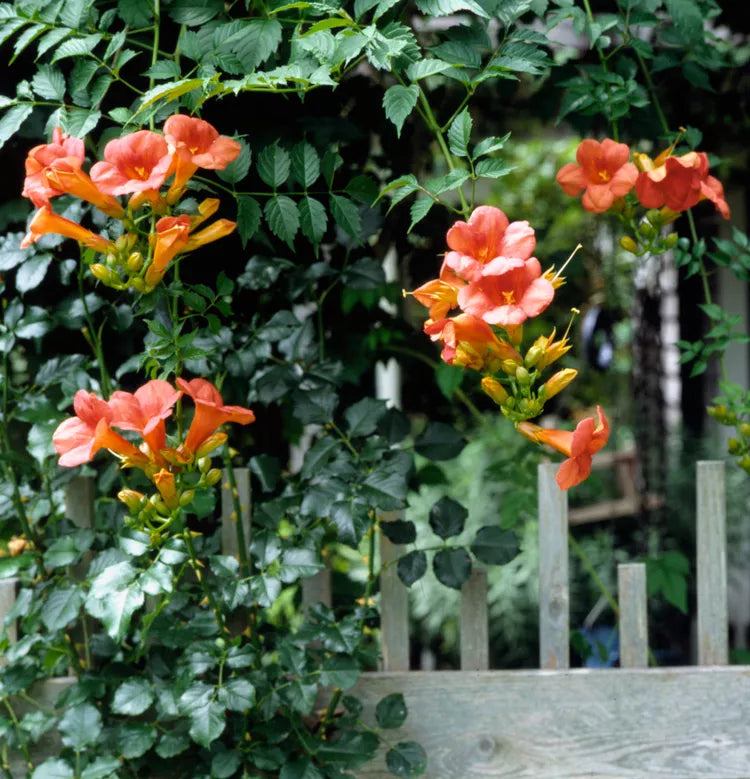
trumpet vine seeds planting Trumpet Vine seeds (Campsis radicans) wild vigor, hummingbird magnet 4 pack x 100 seeds

Sale price$25.89 Regular price$28.77
Save 10%

Pay in installments of $7.19 with ShopPay, AfterPay and Klarna

Shipping Estimate
USA
  • USA
  • CAN

Ships within 48 hours · Estimated delivery Nov 3 - Nov 8

Promo Codes Available:

For Your Every Summer RSVP, with Code: SUMMER15

Description

trumpet vine seeds planting Trumpet Vine seeds (Campsis radicans) wild vigor, hummingbird magnet 4 pack x 100 seedsTL; DR (AI Summary) 400 Trumpet Vine seeds (Campsis radicans) for fast climbing vertical gardens. Produces vibrant orange trumpet flowers that attract hummingbirds. Note: Highly invasive in many states; container growing recommended. Best for: Vertical privacy screens and arbors Best for: Hummingbird and pollinator gardens Best for: Large container gardening on balconies Best for: Fast growing summer coverage in warm climates Not suitable for: Small

TL;DR (AI Summary)

400 Trumpet Vine seeds (Campsis radicans) for fast-climbing vertical gardens. Produces vibrant orange trumpet flowers that attract hummingbirds. Note: Highly invasive in many states; container growing recommended.

  • ✅ Best for: Vertical privacy screens and arbors
  • ✅ Best for: Hummingbird and pollinator gardens
  • ✅ Best for: Large container gardening on balconies
  • ✅ Best for: Fast-growing summer coverage in warm climates
  • ❌ Not suitable for: Small gardens without root barriers (highly invasive)
  • ❌ Not suitable for: Areas near foundations or structures (can cause damage)
  • ❌ Not suitable for: States where listed as invasive without proper containment

Key Features:

  • Quantity: 400 seeds (4 packs of 100)
  • Bloom Color: Bright orange-red trumpet-shaped flowers
  • Growth Rate: Vigorous; 20–40+ ft per season
  • Sun Requirement: Full sun (6–8+ hours daily)
  • Germination: 10–21 days at 70–80°F; no stratification needed

Grow Your Own Trumpet Vine Seeds (Campsis radicans) – Hummingbird Magnet with Fiery Orange Trumpet Flowers for Vertical Privacy Screens, Arbors & Large Container Gardens Nationwide

Trumpet Vine is a vigorous, fast-climbing deciduous vine famous for its showy clusters of bright orange-red trumpet-shaped flowers that bloom profusely all summer and attract hummingbirds in droves. The large, tubular blooms create a stunning vertical display on fences, arbors, trellises, or balconies.

It can grow 20–40+ ft in a single season and is extremely tough once established. In Chicago and cooler zones it performs as a fast summer perennial; in warmer southern and coastal states it becomes a long-term woody vine.

Important Note on Invasiveness: Trumpet Vine is highly aggressive and is listed as invasive or potentially invasive in many U.S. states. It spreads rapidly by underground runners/suckers and self-seeding. It can damage structures, foundations, and outcompete native plants. Strongly recommended to grow only in large containers or areas where you can install root barriers and monitor spread. Always check your state’s invasive species regulations before planting. Consider native alternatives (e.g., Coral Honeysuckle) for responsible hummingbird gardens.

Step-by-Step Growing Guide (Seed to First Blooms in 2–3 Years)

1.  Seed Prep & Sowing
No stratification needed. Sow ¼ inch deep in moist, well-draining potting mix. Germinates in 10–21 days at 70–80°F.

•  Nationwide timing tip: Start indoors 6–8 weeks before last frost. Chicago/Midwest/Northeast: mid to late March. South/Southwest/FL: direct sow March–April. West Coast: March–May.

2.  Planting & Container Setup
Full sun (6–8+ hours). Use very large 15–30+ gallon pots or grow bags with
extremely sturdy, heavy-duty trellis, netting, or balcony railing. Rich, well-draining soil. Space vines 3–5 ft apart if multiple.

3.  Germination & Early Care
Keep soil consistently moist until established. Protect young vines from cool nights or wind. Provide strong support immediately as vines grow rapidly.

4.  Growth & Maintenance
Extremely fast once established. Prune heavily in late winter/early spring to control size and encourage bushier growth. Good airflow prevents mildew in humid areas.

5.  Harvesting / Enjoyment
Blooms heavily from mid-summer until first frost. Deadhead spent flowers to encourage more blooms. Leave some for pollinators and late-season interest.

Pro Tip for Every State: Grow exclusively in large containers with root barriers to contain its aggressive spread and make winter protection easy in cooler zones.

Trumpet Vine Seeds (Campsis radicans) – Detailed 50-State Sowing Calendar 

Trumpet Vine is a hardy deciduous woody vine (USDA zones 4–9) that is very cold-tolerant once established but can be slow to germinate from seed and takes 2–3 years to reach full blooming size. It is extremely vigorous and aggressive (invasive in many areas), so container growing with root barriers is strongly recommended everywhere.

Key rules that apply to every state:

  • No cold stratification needed.
  • Start indoors 6–8 weeks before your last spring frost date.
  • Transplant or direct sow after all danger of frost has passed and soil is warm (60°F+).
  • Provide very sturdy, heavy-duty support (trellis, arbor, or balcony railing) — vines can reach 20–40+ ft.
  • In USDA zones 4–6 grow as a fast summer perennial; in zones 7–9 it becomes a long-term woody vine.

Detailed 50-State Sowing Calendar (Grouped by Region for Easy Reading)
Dates are averages based on 50% probability last spring frost and typical 2026 conditions. Adjust ±7–10 days for your exact microclimate or elevation.

Region / States

Indoor Start

Transplant / Direct Sow

Notes / Example Cities

Northeast (ME, NH, VT, MA, RI, CT, NY, PA, NJ)

March 1 – March 20

May 15 – June 5

New York City: Indoor mid March → Transplant late May–early June

Midwest & Great Lakes (IL, IN, OH, MI, WI, MN, IA, MO, ND, SD, NE, KS)

March 5 – March 25

May 10 – June 1

Chicago, IL: Indoor mid March → Transplant late May

Mid-Atlantic & Upper South (DE, MD, DC, VA, WV, KY, NC, TN)

Feb 20 – March 15

May 1 – May 25

Washington DC: Indoor early March → Transplant mid May

Southeast & Gulf (SC, GA, AL, MS, AR, LA, OK)

Feb 10 – March 5

April 20 – May 15

Atlanta: Indoor late Feb → Transplant late April–early May

Texas

North: Feb 20 – March 10

Central/South: Feb 1–March 1

North: mid April–early May

Central/South: late March–mid April

Dallas: Indoor early March → Transplant mid April

Houston: Direct sow March

Florida

North: Jan 20 – Feb 20

Central/South: Jan–Feb

North: March–April

Central/South: Feb–April (year-round possible in south)

Miami: Direct sow Feb onward

Southwest (AZ, NM, UT, NV)

Late Feb – mid March

April 15 – May 10

Phoenix: Direct sow late Feb–March

Flagstaff: Indoor March → Transplant May

Mountain & Northern West (CO, ID, MT, WY)

Late March – early April

Late May – early June

Denver: Indoor early April → Transplant late May–early June

Pacific Northwest (WA, OR)

Late March – early April

Late May – early June

Seattle: Indoor late March → Transplant late May–early June

California

Northern/Coastal: Feb 20 – March 20

Southern/Inland: Feb 1–March 1

March–May

Los Angeles: Direct sow Feb–April

San Francisco: March–May

Alaska

Late April – May

June (short season)

Anchorage: Very short season — best as container plant

Hawaii

Not needed

Year-round (best Feb–June)

Honolulu: Direct sow any time; peak growth in warmer months

Pro Tips for Every State

  • Chicago / Midwest / Northeast gardeners: Start indoors under grow lights in mid March for strong transplants ready around Memorial Day weekend. Use large 15–30+ gallon containers with heavy-duty trellising.
  • Southern & Southwestern gardeners: Direct sowing works very well once nights stay reliably above 60°F. Provide consistent moisture and strong support.
  • Container / balcony growers: 15–30+ gallon pots or grow bags with very sturdy vertical support are perfect for urban spaces and easy to move during heat waves or bring indoors before frost.
  • Invasiveness awareness: This vine spreads aggressively by underground runners. Container growing with root barriers is strongly recommended to keep it contained.

🌺🐦

Key Benefits

  • High germination rate when properly stored
  • Non-GMO, open-pollinated variety
  • Suitable for containers or garden beds
  • Save seeds from mature plants for next season
  • Detailed growing instructions included

How to Use

  1. Start seeds 1–2 cm deep in moist seed-starting mix
  2. Keep soil consistently moist at 18–24°C for germination
  3. Expect sprouts in 7–21 days depending on variety
  4. Thin or transplant seedlings when 5–8 cm tall
  5. Harden off before outdoor transplanting
  6. Harvest when plants reach maturity

Specifications

Quantity: 4 pack × 100 seeds. Type: Open-pollinated. Germination: 70–85% (typical). Viability: 2–4 years sealed.

Care & Storage

Store seeds in a cool, dark, dry place. Refrigerator storage extends viability. Keep sealed until planting.

Key Terms

  • Campsis radicans — Scientific name for trumpet vine from seed
  • Trumpet Vine from Seed — Popular garden plant grown from seed
  • Germination — The process of a seed sprouting into a seedling
  • Open-pollinated — Seeds that breed true to parent plant

Who Should Not Use

  • Not for consumption—planting seeds only
  • Keep away from children and pets
  • Check local regulations for any restrictions

There's something hopeful about planting seeds—each one a small act of faith in tomorrow.

Shipping Notes
  • Free Standard Shipping on $100+ Orders to the USA.
  • Except Preorder products are shipped in 48 hours.
  • Delivery to the USA:
  1. Standard Shipping : 3-10 business days
  • If time is of the essence, please consider selecting expedited delivery for faster service.
Exchange/Return Notes
  • We offer a 30-day return/exchange service after receiving.
  • Final sale items are not eligible for returns or exchanges.
  • To process your return/exchange, please contact us at [email protected]
  • Please click here for more details>>> Return & Exchange Policy
SKU: 40397161389

Discover Niche Categories That Outsell trumpet vine seeds planting

Top-Converting Item to Boost Your Average Order

4.2 ★★★★★
Based on 29 reviews
Sort
Highest Rating
Newest First
Oldest First
Product Reviews
K
Verified Purchase
KK
Boise, US
★★★★★ 1
Poor product
Blade was not sharp enough to remove hair. The raggedy blade scratched and but my face. Very disappointed. My granddaughter had a different brand of this item and it was so smooth removing the hair.
WAS THIS REVIEW HELPFUL?YesReportShare
Reviewed in the United States on January 24, 2026
B
Verified Purchase
Brian Johnson | Philosopher's Notes
Cuba, US
★★★★★ 5
I absolutely loved this book.
Format: Paperback
“This book is about creativity, based on histories of contemporary people who know about it firsthand. It starts with a description of what creativity is, it reviews the way creative people work and live, and it ends with ideas about how to make your life more like that of the creative exemplars I have studied. There are no simple solutions in these pages and a few unfamiliar ideas. The real story of creativity is more difficult and strange than many overly optimistic accounts have claimed. For one thing, as I will try to show, an idea or product that deserves the label ‘creative’ arises from the synergy of many sources and not only from the mind of a single person. It is easier to enhance creativity by changing conditions in the environment than by trying to make people think more creatively. And a genuinely creative accomplishment is almost never the result of a sudden insight, a lightbulb flashing on in the dark, but comes after years of hard work.” ~ Mihaly Csikszentmihalyi from Creativity Creativity with a capital C—the type of Creativity that changes the world. How can we go about cultivating it in our lives? That’s what this book is all about. Our guide is Mihaly Csikszentmihalyi—one of the founders of the positive psychology movement. Csikszentmihalyi (pronounced “cheeks sent me high”) is a professor at Claremont Graduate University and the former Chair of the Department of Psychology at the University of Chicago who wrote the classic book Flow: The Psychology of Optimal Experience . This book features the wisdom gained from over three decades of research along with over one hundred interviews with extraordinary people—from scientists and business leaders to artists and poets. Warning: Although deeply insightful, it’s not an easy read. If you’re looking to understand creativity at a deeper level via one of the world’s leading (and legendary) psychologists then I think you’ll enjoy it as much as I did. Here are some of my favorite Big Ideas: 1. What is Creativity - Domain + field + person. 2. Attention - + Being kind weird 3. Complexity - + Resolving dischotomies. 4. Rhythms - Your ideal days? 5. Creativity + Flow - The 9 elements Well, there we go. That’s a super quick look at this great book. Time to get our flow on as we tap into our Creativity and optimize + actualize! More goodness— including PhilosophersNotes on 300+ books in our ​*OPTIMIZE*​ membership program. Find out more at brianjohnson . me.
WAS THIS REVIEW HELPFUL?YesReportShare
Reviewed in the United States on May 10, 2016
J
Verified Purchase
Julie S.
Los Angeles, US
★★★★★ 5
5 Stars – A Must-Read for Anyone Interested in Creativity!
Format: Paperback
Creativity: The Psychology of Discovery and Invention* by Mihaly Csikszentmihalyi is a brilliant exploration of the inner workings of creativity and the human mind. Whether you’re an artist, entrepreneur, or simply someone interested in understanding how creative breakthroughs happen, this book provides a fascinating blend of psychology, real-world examples, and deep insights. What sets this book apart is its comprehensive approach to creativity, going beyond the idea of it being a mysterious or innate trait. Csikszentmihalyi breaks down the creative process into digestible parts, showing how environment, discipline, curiosity, and flow all play a crucial role in fostering creative discovery. The interviews with a wide variety of highly creative people—including scientists, artists, and business leaders—add incredible depth and context to his theories. One of my favorite takeaways is how Csikszentmihalyi emphasizes the balance between freedom and structure in creative work, and how finding the "flow" state can lead to moments of true innovation. The book not only helped me better understand my own creative process but also offered practical advice for cultivating creativity in everyday life. This is an insightful, inspiring read for anyone who wants to dive deeper into the psychology behind creative genius. Highly recommend!
WAS THIS REVIEW HELPFUL?YesReportShare
Reviewed in the United States on September 10, 2024
M
Verified Purchase
M. Edwards
Draper, US
★★★★★ 4
Personal Creativity does not equal Domain Transformation
This was a good if not a great book. Its greatest strength lies in the thesis introduced early on and supported throughout that the kind of creativity that leaves a trace in the cultural matrix rests not in the personal creativity of the individual, but in what Csikszentmihalyi tags the "systems approach " to creativity. To have any effect, a creative idea must be couched in terms that are understandable to others, pass muster with the experts in the field (i.e. the gatekeepers to the domain), and be included within the cultural domain (the set of symbolic rules or procedures) to which it belongs. In this systems view, the definition of a creative person is someone whose thoughts or actions change a domain or establish a new domain (pp. 27-28). This is no easy task, especially since he or she needs to learn the existing domain or domains first, and almost always necessitates being in the right place at the right time (e.g. studying quantum physics at the beginning of the 20th century or women seeking academic opportunities when WWII broke out). Having established this in the first 30 pages, if you didn't read the remaining 350 you wouldn't miss much. But I still enjoyed reading the stories and thoughts of selected individuals whom the author deemed as "creative" according to the definition above (However, I disagreed with the selection of a few of these and would have chosen at least one more person of faith in addition to the Quaker who was briefly highlighted. Also on the issue of faith, I found the author's grouping on page 371 of studying the bible with addictive behaviors such as cruising the internet and betting on horse races to be rather laughable!). Some additional personal nuggets I gleaned from this book include the following: 1. Those who persevere and succeed must be creative not only in their manipulation of symbols but maybe even more in shaping a career and a future for themselves that will enable them to survive while continuing to explore the strange universe in which they live (p. 199). 2. When seeking to allow your mind to make new connections in a beautiful setting, just sitting and watching is fine, but taking a leisurely walk seems to be even better. The shaping of one's personal space is also important. The Greek philosophers settled on the peripatetic method, preferring to discuss ideas walking up and down in the courtyards of the academy. When we participate in this kind of "semiautomatic activity" that uses a certain amount of attention, we allow the rest of it to be free to make connections among ideas, often from different domains, well below the threshold of conscious intentionality. "Devoting full attention to a problem is not the best recipe for having creative thoughts. "(p. 138) 3. Both creativity and innovation on the one hand and conservation and traditionalism on the other are both equally important. "Neither uncritical acceptance nor wholesale dismissal of human creativity will lead us far. " (p. 322) The final section deals with how to enhance personal creativity. Some of these ideas were helpful (e.g. to seek to be surprised and to seek to surprise another person at least once every day, to seek to look at problems from multiple perspectives instead of assuming you see the issue clearly from one perspective, etc.) but others just seem to be taking up space on the page. I'm afraid the phraseology of how to use psychic energy more effectively on page 356 and a few other places lost my interest almost completely.
WAS THIS REVIEW HELPFUL?YesReportShare
Reviewed in the United States on November 15, 2010
P
Verified Purchase
pepe
Pawtucket, US
★★★★★ 5
interesting analysis of what 'being creative' really means
This easy-to-read absorbing book is based on lengthy interviews with 91 creative individuals ranging from Nobel prize winners to artists to CEOs. Csikszentmihalyi starts by debunking the myth of 'the lone genius having a brilliant idea as if by magic' and defines three necessary ingredients for creativity ('with a capital "C"') - domain, field, and individual. Creativity must take place within a recognised domain (such as physics, painting and so forth); be recognised by experts in that domain (the field, although this may not happen in the individual's lifetime, eg, Van Gogh); and of course come from an individual, although he also adds the painstaking work that precedes and insight, the reality that all creativity builds on what has gone before, and the social elements of the creative process. The book also offers supporting evidence from the lives of the 91 interviewed, which also provides interesting insights into their lives. In many ways, this book is a biography of the creative individual. Also contains a chapter with quite practical guidance on how to live more creatively. Prescient advice for a book published in 1996 given the increasing profile creativity is getting in business and public life. HIghly recommended, one of the most interesting learning experiences i have had in a long while!
WAS THIS REVIEW HELPFUL?YesReportShare
Reviewed in the United States on February 5, 2013

recommand products