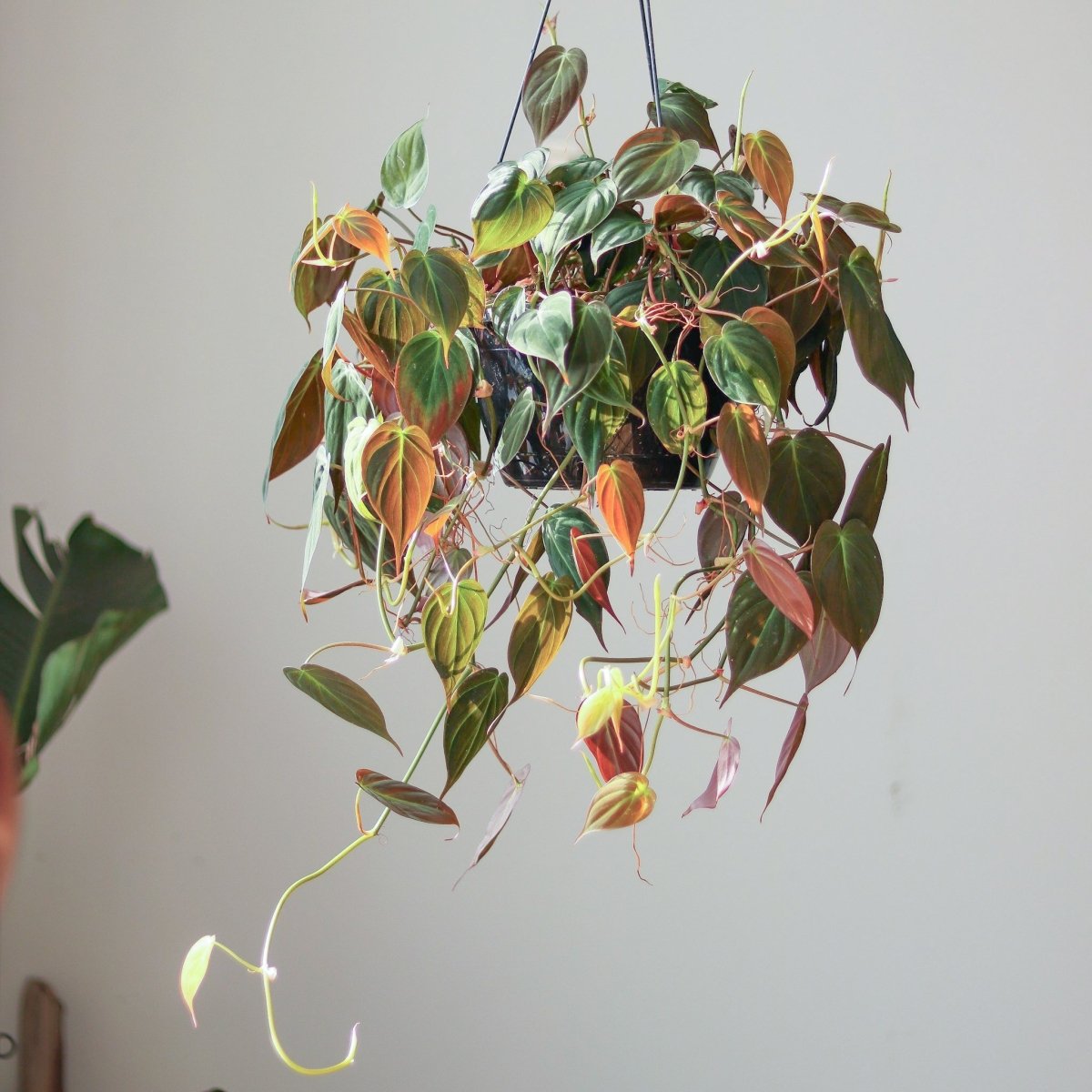
SKU: 71516296157
philodendron hederaceum 'micans'

philodendron hederaceum 'micans' Mican Philodendron - Velvet Leaf - Live Starter Plants - Philodendron Hederaceum

Sale price$19.94 Regular price$22.16
Save 10%

Pay in installments of $5.54 with ShopPay, AfterPay and Klarna

Shipping Estimate
USA
  • USA
  • CAN

Ships within 48 hours · Estimated delivery Nov 3 - Nov 8

Promo Codes Available:

For Your Every Summer RSVP, with Code: SUMMER15

Description

philodendron hederaceum 'micans' Mican Philodendron - Velvet Leaf - Live Starter Plants - Philodendron HederaceumWhy the Micans Philodendron is a Must Have Plant The Micans Philodendron is cherished for its soft, velvety leaves and trailing vines. Its dark green to purple leaves offer a unique texture, making it an elegant addition to any indoor space. Perfect for both beginners and seasoned plant parents, this philodendron is easy to care for and adds instant sophistication to your collection. Plant Profile Botanical Name: Philodendron Pronunciation: fil oh DEN

Why the Micans Philodendron is a Must-Have Plant

The Micans Philodendron is cherished for its soft, velvety leaves and trailing vines. Its dark green to purple leaves offer a unique texture, making it an elegant addition to any indoor space. Perfect for both beginners and seasoned plant parents, this philodendron is easy to care for and adds instant sophistication to your collection.


Plant Profile

  • Botanical Name: Philodendron
  • Pronunciation: fil-oh-DEN-dron 
  • Common Name: Philo micans, Micans, Velvet-leaf Philodendron, Heart-leaf philodendron
  • Family: Araceae
  • Native Range: Native to the Caribbean and Mexico

How to Care for Philodendron Micans

  • Care Level: Easy
  • Light: Prefers bright light for best growth. Avoid direct sunlight as the leaves may burn and dry out quickly.
  • Water: Water when soil is dry. Water from above and allow the water to drain out the drainage holes. Avoid over-watering. When underwatered, the leaves will begin to droop.
  • Humidity: Appreciates humid environment. Can tolerate average household humidity. Will maintain their best appearance when placed next to a humidifier or in a humid environment during the dry winter months. 
  • Temperature: 60-75F for optional growth. Avoid cold drafts. Avoid placing next to heating or air conditioning vents.
  • Pruning: Prune as needed to remove brown or dead leaves and control growth.
  • Feeding: Fertilize with an all-purpose liquid plant food during spring and summer. 
  • Propagation: Easily propagated from stem cuttings in water or soil
  • Growth: Known to be a slow grower
  • Pests: Generally not subject to pests. Look out for fungus gnats.
  • Toxicity: Toxic to humans and pets

Fun Fact: A Living Velvet

The Micans Philodendron is often called the "velvet leaf philodendron" due to the velvety texture of its leaves. This unique characteristic gives it an almost luxurious, fabric-like feel, setting it apart from other trailing houseplants.

History of the Micans Philodendron: From the Wild to Your Living Room

The Micans Philodendron is a cultivar of Philodendron hederaceum, native to Central and South America. Though the species has been known for centuries, the Micans variety gained popularity among indoor plant enthusiasts in the 1990s, thanks to its appealing, velvet-like leaves and ease of care. Its ability to thrive indoors made it a favorite in modern homes and offices.

Grow Like A Pro With Our Advanced Micans Philodendron Care Guide

Want to help your Micans Philodendron thrive? Check out our expert-written Philodendron Care Guide for everything you need to know—from watering tips to creating the perfect environment. Your plant will thank you!

Shipping Notes
  • Free Standard Shipping on $100+ Orders to the USA.
  • Except Preorder products are shipped in 48 hours.
  • Delivery to the USA:
  1. Standard Shipping : 3-10 business days
  • If time is of the essence, please consider selecting expedited delivery for faster service.
Exchange/Return Notes
  • We offer a 30-day return/exchange service after receiving.
  • Final sale items are not eligible for returns or exchanges.
  • To process your return/exchange, please contact us at [email protected]
  • Please click here for more details>>> Return & Exchange Policy
SKU: 71516296157

Discover Niche Categories That Outsell philodendron hederaceum 'micans'

Top-Converting Item to Boost Your Average Order

4.9 ★★★★★
Based on 26 reviews
Sort
Highest Rating
Newest First
Oldest First
Product Reviews
K
Verified Purchase
Ken Kardash
Omaha, US
★★★★★ 4
Rediscovering America
This is an eye-opening, scholarly rebuttal to common perceptions about native American society before and after the European invasion. Ronald Wright makes no secret of his bias in favor of the people who were here first; in fact, he enhances the impact of what for many will be new information by presenting this extraordinary history from the point of view of the conquered. He also makes clear how large a part of the conquest was due to immune system rather than military deficiencies: if smallpox and other diseases had not done killed most of the native population, the facts recounted here suggest that history, particularly in South America, may have evolved quite differently. In undertaking the massive task of recounting the invasion of all of the Americas, some selectivity is inevitable. Wright has chosen to focus on the story of five distinct native groups: Aztec, Maya, Inca, Cherokee and Iroquois. He then arbitrarily subdivides the story into three consecutive time periods: Conquest, Resistance and Rebirth. After the physical and political annihilation recounted in the first two sections, the title of the third may seem overly optimistic, particularly for the Guatemalan Maya. However, the concluding tone is more conciliatory and hopeful than mournful, particularly in the Afterword that updates matters to 2005, 13 years after the original publication date. The astounding amount of research involved in producing this admittedly selective overview is well-indexed and annotated. My only quibble is that Wright, obviously an expert in the field of native culture, sometimes borders on the compulsive in matters of linguistic authenticity. I did not buy this book to learn ancient native languages, let alone their pronunciation, and at times I found the inclusion of such trivia distracted from rather than enhanced the otherwise convincing scholarship. This obsession with accuracy is commendable, but after getting it out of his system in the Author's note, his amazing narrative would have been no less compelling if he stuck to the language of his contemporary audience. Also, for an author who has settled in British Columbia, it is strangely disappointing that the rich history of the Pacific Northwest coastal natives was not among those he chose to examine. I had read Charles Mann's "1491" prior to this book and found it primed my interest in the subject; both are excellent introductions to the reality of pre-Columbian American societies, but Stolen Continents provides more of a historical context for what has become of them.
WAS THIS REVIEW HELPFUL?YesReportShare
Reviewed in the United States on October 13, 2008
I
Verified Purchase
Irving Dozier
Omaha, US
★★★★★ 5
... true things that really went on to know very great
Format: Hardcover
lots of true things that really went on to know very great book
WAS THIS REVIEW HELPFUL?YesReportShare
Reviewed in the United States on October 13, 2016
A
A. Jimenez
Houston, US
★★★★★ 3
Well intentioned but ignorant
It's clear that this author is well intentioned. He betrays his own ignorance in trying to justify why his book only addreses certain native nations, however. The author indicates that the book did not address the native peoples of the Caribbean because they are extinct. To state that the Taino and Carib are extinct is at best extremely ignorant and at worst racist. The Taino and Carib are very much alive. To begin with, there is a reservation of Carib Indians on the island of Dominica. These native people have retained their language and culture. Further, there is a Taino Revival movement happening throughout the major Antilles especially in the Dominican Republic, Puerto Rico and Cuba. It has been scientifically proven via DNA analysis that these people are of partial and in some cases total native descent. The Taino language is being heard and taught again in the Caribbean and Taino culture has always been an integral part of the the customs and culture of the major Antilles. It is very unfortunate to know that even this author is ultimately just another white guy bent on ignoring " incovenient truths ".
WAS THIS REVIEW HELPFUL?YesReportShare
Reviewed in the United States on September 25, 2012
T
Verified Purchase
Terry L.
Los Angeles, US
★★★★★ 5
Recommend
Tells the other side of the story you didn't get in U.S. History class. Good read.
WAS THIS REVIEW HELPFUL?YesReportShare
Reviewed in the United States on May 15, 2015
G
Verified Purchase
George Vargas
Chelsea, US
★★★★★ 5
Five Stars
Outstanding book on the general history of European barbarism.
WAS THIS REVIEW HELPFUL?YesReportShare
Reviewed in the United States on December 26, 2017

recommand products