SKU: 89459181811
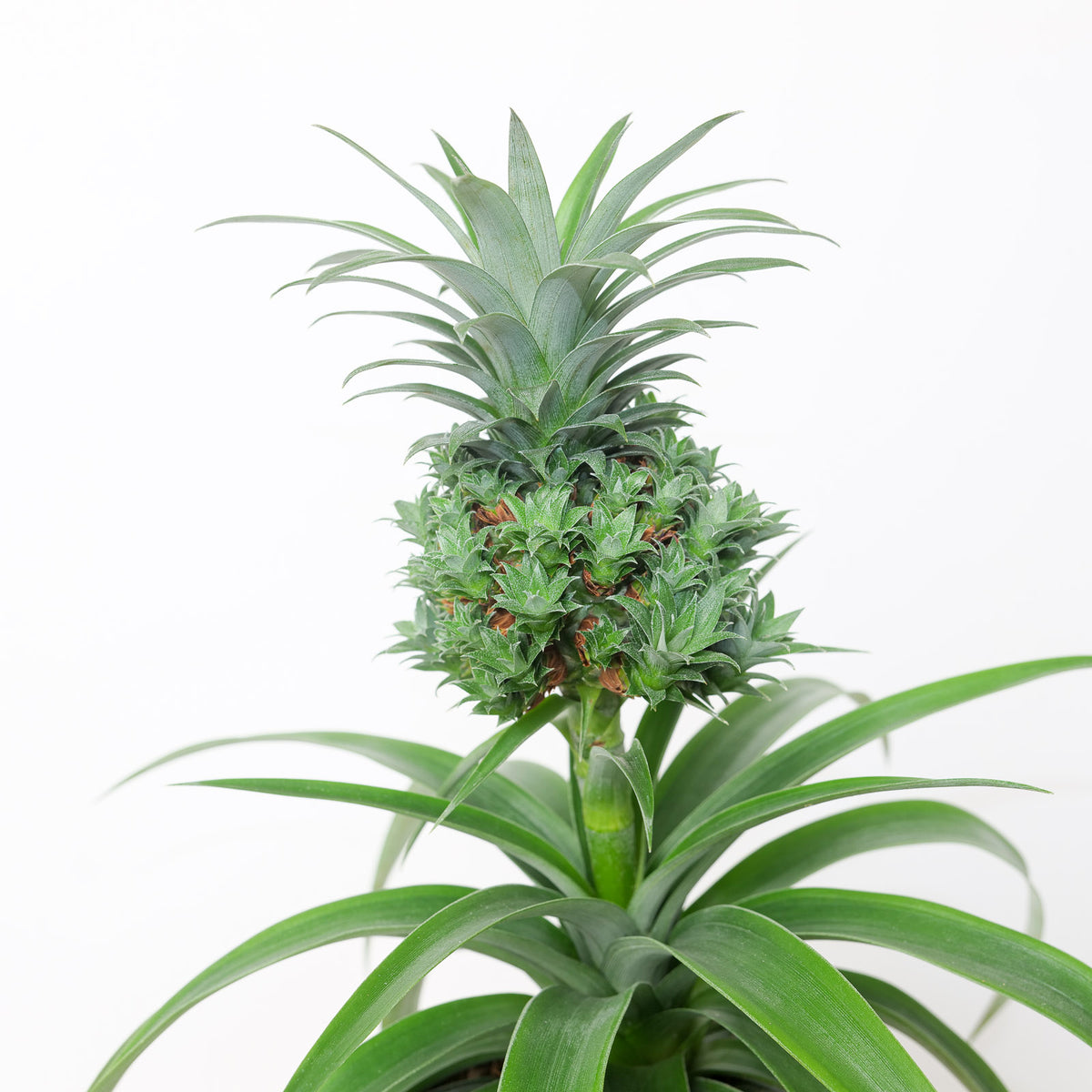
drooping pineapple plant

drooping pineapple plant Ananas 'Baby Boom' | Plants

Sale price$21.21 Regular price$23.57
Save 10%

Pay in installments of $5.89 with ShopPay, AfterPay and Klarna

Shipping Estimate
USA
  • USA
  • CAN

Ships within 48 hours · Estimated delivery Nov 3 - Nov 8

Promo Codes Available:

For Your Every Summer RSVP, with Code: SUMMER15

Description

drooping pineapple plant Ananas 'Baby Boom' | PlantsAnanas Baby Boom is a compact ornamental pineapple cultivar bred for it's incredible inflorescence covered in baby pineapple plants. You have to see it to believe it! Native to: Pineapples are native to tropical South Americaparticularly the ParanParaguay basin of southern Brazil, Paraguay and Bolivia. Leaves are long, narrow, swordshaped with slightly serrated margins; young foliage may show hints of purple or bronze before maturing to greygreen.

Ananas Baby Boom is a compact ornamental pineapple cultivar bred for it's incredible inflorescence covered in baby pineapple plants. You have to see it to believe it!

Native to: Pineapples are native to tropical South America—particularly the Paraná–Paraguay basin of southern Brazil, Paraguay and Bolivia. Leaves are long, narrow, sword‑shaped with slightly serrated margins; young foliage may show hints of purple or bronze before maturing to grey‑green. Growth habit is a rosette that eventually bears a small central pineapple, followed by pups on the pineapple.

Water: Water thoroughly when the top third of the potting medium feels dry. In summer, aim for about once a week indoors; in cooler months reduce frequency. Avoid waterlogging—excess moisture causes root or stem rot. Drain any water from the rosette cup to prevent rotting.

Light: Requires bright filtered to indirect light at least 6 hours daily. A south‑facing window is ideal indoors. Direct intense sun may scorch leaf edges, so protect them in the hottest periods. Insufficient light may delay flowering and fruit set.

Humidity: Prefers moderate to relatively high humidity. Light weekly misting or the use of a pebble tray can improve leaf health. While humidity rarely needs to exceed about 60 %, prolonged indoor dryness may cause brown leaf tips, so raise humidity slightly if needed. Does not require terrarium enclosure unless air is very dry but avoid fully enclosed terrariums, as this plant will often grow larger and benefit from airflow.

Temperature: Ideal indoor range is roughly 18 °C to 30 °C. It can tolerate down to about 15 °C briefly but prolonged lower temperatures particularly below 15 °C can injure the plant. Never expose to frost. Mature fruit production may be slower at the lower end of its temperature tolerance.

Shipping Notes
  • Free Standard Shipping on $100+ Orders to the USA.
  • Except Preorder products are shipped in 48 hours.
  • Delivery to the USA:
  1. Standard Shipping : 3-10 business days
  • If time is of the essence, please consider selecting expedited delivery for faster service.
Exchange/Return Notes
  • We offer a 30-day return/exchange service after receiving.
  • Final sale items are not eligible for returns or exchanges.
  • To process your return/exchange, please contact us at [email protected]
  • Please click here for more details>>> Return & Exchange Policy
SKU: 89459181811

Discover Niche Categories That Outsell drooping pineapple plant

Top-Converting Item to Boost Your Average Order

4.9 ★★★★★
Based on 11 reviews
Sort
Highest Rating
Newest First
Oldest First
Product Reviews
C
Verified Purchase
C Rasmussen MD, MS
Waukegan, US
★★★★★ 5
Horrifying but it is a must read
Format: Paperback
This book should be required reading for all high-school students rather than the friendly history books that treat Columbus as a hero. This man was a murderous psychopath. Strong words but after reading this powerful text you will agree. I am ashamed at what these monsters from Spain, and England and elsewhere did soon after Columbus "discovered" the Americas. And all of the sacred knowledge lost. Everything the Mayans wrote down was burned. Knowledge from prehistory--all gone. All of the knowledge from prehistory the Indians in the Amazon basin held, all of the technology on agriculture, building, medicine, sacred knowledge, and much more gone. And for what? I cannot tell you how powerful this book is. I cannot get it out of my head. If you think black lives matter well, sorry folks indigenous Indians of the New World MATTER MORE. They should be rioting for compensation from Spain and England. Oh, I forgot, nobody's left to riot. It was a complete deliberate genocide killing perhaps 80 million paleo-indians from the 15th century on. And they are still killing the rest of them in Mesoamerica and esp. the Amazon where oil and mineral companies are murdering the remainder. And nobody seems to care! Read this book and learn the truth finally.
WAS THIS REVIEW HELPFUL?YesReportShare
Reviewed in the United States on September 19, 2020
L
Verified Purchase
Leric ashe
Battle Creek, US
★★★★★ 5
In 600yrs. , life itself, is elusive
Format: Paperback
American Holocaust or books related to the Native American should be required reading. The carnage or genocide, on the inflicted erased thousands of years of culture. We have lost so much which makes us, all less. Hispaniola, had a population of 8,000,00, in 1496. By 1535 they were extinct. Equivalent to N.Y. city today. Spanish and British. One looking for gold, the latter imposing European values, to steal land. But what was most fascinating, the religious hypocrisy. To kill, enslave, torture in the name of God. Who snatches babies from their mother, and feeds them to dogs, hanging natives from a gibber, and burned alive, brand enslaved women's faces every time they are resold ? The British and Spanish were the "Very ministers of Hell".
WAS THIS REVIEW HELPFUL?YesReportShare
Reviewed in the United States on November 19, 2023
T
Verified Purchase
Tameka Hanford
Phoenix, US
★★★★★ 5
Academic / Thought-Provoking
Format: Paperback
They Were Her Property: White Women as Slave Owners in the American South is a powerful, eye-opening work that challenges long-held assumptions about slavery and gender in American history. Stephanie E. Jones-Rogers thoroughly dismantles the myth that white women were passive or marginal participants in the institution of slavery. Through meticulous research and extensive use of primary sources, including legal records, letters, and testimonies from formerly enslaved people—the book reveals that many white women were active, knowledgeable, and often brutal slave owners in their own right. What makes this book especially compelling is how it centers the voices and experiences of enslaved people to expose the economic, legal, and physical power white women wielded. Jones-Rogers shows that white women not only benefited from slavery but also enforced it, defended it, and used it to build wealth and social status. The writing is clear, authoritative, and accessible, making complex historical arguments understandable without oversimplifying them. This book is an essential read for anyone studying American history, slavery, race, or gender. It forces readers to confront uncomfortable truths and rethink narratives that have long softened or excused the role of white women in slavery. They Were Her Property is both academically rigorous and deeply impactful—a necessary contribution to honest historical understanding.
WAS THIS REVIEW HELPFUL?YesReportShare
Reviewed in the United States on December 16, 2025
E
Verified Purchase
Eric Hobart
Lowell, US
★★★★★ 5
Remarkable analysis of slaveholding women in Antebellum America
Format: Paperback
Stephanie Jones-Rogers has provided us with a book that looks at the South's "peculiar institution" through a very different lens - the slaveholders/slaveowners, but this analysis looks at women that owned slaves, thus opening up a new avenue of study that I hadn't previously seen. Jones-Rogers offers a well written account that is rich in historical details. She demonstrates through vivid historical evidence that the women that owned enslaved people were primarily driven by economic motives, and that these women were just as demanding and could be just as harsh as the "typical" slaveowner image that has been crafted over the years. The book is organized thematically, and each chapter demonstrates the economic motivation behind slave ownership. The reader is offered views of everything from young children becoming slave owners when their parents "gifted" them an enslaved person, and how these young girls were taught that this was "property" that could be used as desired to how these female slaveholders would sell their slaves to meet their economic goals. All told, this is a fascinating book that uncovers a long ignored slice of Antebellum American history that makes the historiographical literature of pre-Civil War history much richer.
WAS THIS REVIEW HELPFUL?YesReportShare
Reviewed in the United States on June 4, 2021
B
Verified Purchase
Becca
Chelsea, US
★★★★★ 5
Poignant, truthful look at women as powerful, business-savvy, yet brutal slave owners
Format: Paperback
Women slave owners were the norm in the South, not the exception. They increased in numbers, stature, and power while the men were off fighting the Civil War. Women often owned the slaves, not the men and knew how to sign prenuptial agreements back then to insure they kept all their property (including slaves) upon divorce or death of their spouse. They traded and bought and sold slaves with business savvy that most men envied. And they could be just as brutal towards their slaves. Ironically, it was the ownership of other people that empowered these women to not be bound to their husbands.
WAS THIS REVIEW HELPFUL?YesReportShare
Reviewed in the United States on January 26, 2025

recommand products