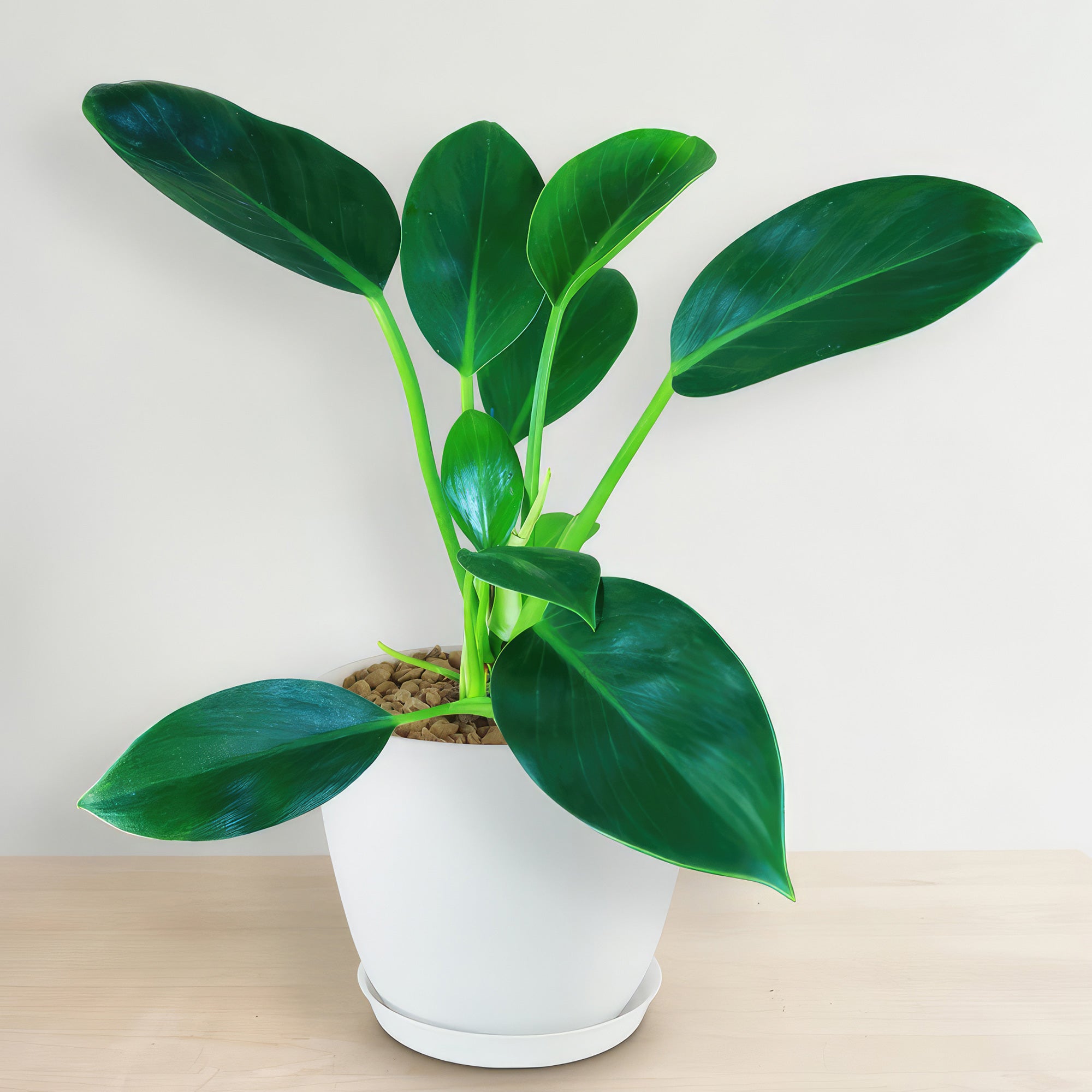
SKU: 94979979014
philodendron indoors

philodendron indoors ‘Green Princess’ Philodendron 6" Pot / Self Watering / Without Pot

Sale price$20.99 Regular price$23.32
Save 10%

Pay in installments of $5.83 with ShopPay, AfterPay and Klarna

Shipping Estimate
USA
  • USA
  • CAN

Ships within 48 hours · Estimated delivery Nov 26 - Dec 1

Promo Codes Available:

For Your Every Summer RSVP, with Code: SUMMER15

Description

philodendron indoors ‘Green Princess’ Philodendron 6" Pot / Self Watering / Without PotKey Highlights Philodendron Green Princess The Philodendron Green Princess is known for its glossy, deep green leaves, which add a vibrant and tropical feel to any indoor space. Its compact, bushy growth makes it perfect for desks, shelves, or small corners. The thick, waxy leaves store moisture, allowing the plant to withstand short periods of drought. This makes it a low maintenance choice for those who may occasionally forget to water. It helps to

Key Highlights - Philodendron ‘Green Princess’ 

  1. The Philodendron Green Princess is known for its glossy, deep-green leaves, which add a vibrant and tropical feel to any indoor space. Its compact, bushy growth makes it perfect for desks, shelves, or small corners.
  2. The thick, waxy leaves store moisture, allowing the plant to withstand short periods of drought. This makes it a low-maintenance choice for those who may occasionally forget to water.
  3. It helps to remove toxins such as formaldehyde, thereby improving indoor air quality.
  4. Unlike many philodendrons that trail or climb, ‘Green Princess’ grows in a compact, upright shape, making it ideal for small spaces without the need for support or pruning.

The Philodendron ‘Green Princess’ is a stunning, and beloved evergreen-perennial known for its glossy, deep-green foliage and easy-care nature. This tropical plant is an excellent choice for both beginners and experienced plant enthusiasts due to its adaptability and resilience. Unlike vining philodendrons, ‘Green Princess’ has a more upright, bushy growth habit, making it ideal for indoor spaces where a structured, lush appearance is desired. 

Like most philodendrons, ‘Green Princess’ originates from the tropical rainforests of Central and South America. Due to its popularity as a houseplant, it is now widely cultivated in greenhouses and nurseries worldwide. 

One of the most striking features of the ‘Green Princess’ Philodendron is its lush, deep-green foliage.

The leaves are smooth, slightly elongated, and have a glossy finish, which enhances their vibrant appearance.

Unlike climbing philodendrons, this variety remains compact and bushy, making it perfect for tabletops, shelves, and small indoor spaces.

The plant is also known for being low-maintenance, tolerating lower light conditions, and requiring minimal care compared to other tropical houseplants.

When grown indoors, this ‘Green Princess’ plant typically grows up to 10 inches tall and spreads about 10 inches wide.

Its slow-growing nature makes it easy to manage, and with occasional pruning, it can maintain a tidy, bushy form. While it can grow larger under optimal conditions, it remains significantly smaller than climbing philodendron varieties. 

The flowers of Green Princess Philodendron bloom in spring and summer. The flowers have white petal-like structures called spathes, with a green center (spadix). While this plant is mainly grown for its leaves, these rare flowers can add a nice touch of color to your home. 

The Philodendron Green Princess is a compact and versatile plant, making it perfect for small spaces and a variety of indoor settings. This natural air purifier helps trap dust and improve air quality, while also requiring minimal care, making it ideal for beginners. With its mood-boosting greens, the Philodendron Green Princess adds vitality and a soothing presence to your home, creating a welcoming and refreshing atmosphere.  

When and How to Water Your Philodendron Green Princess 

Philodendron ‘Green Princess’ is a drought-tolerant plant that can withstand periods of dryness, making it an excellent choice for plant owners who may occasionally forget to water. The plant’s thick, glossy leaves help retain moisture, allowing it to survive short dry spells. To ensure proper hydration, always check the soil’s moisture level before watering—water only when the top 1-2 inches of soil feel dry.

In the spring and summer, during the active growing season, the ‘Green Princess’ Philodendron requires more frequent watering to support its lush foliage and steady growth. Typically, watering once every 7 to 10 days is sufficient, but this may vary based on climate and indoor conditions. If grown outdoors, more frequent watering may be necessary during extreme heat. To promote even growth, use lukewarm water and ensure proper drainage. 

In the fall and winter months, the plant enters a semi-dormant stage, requiring significantly less water. Reduce watering frequency to once every 2 to 3 weeks, allowing the soil to dry out more between waterings. Lower temperatures and reduced light exposure slow down growth, minimizing the plant’s water needs. However, ensure the air is not too dry by maintaining adequate humidity. 

Light Requirements – Where to Place Your Green Princess Philodendron 

When growing indoors as a houseplant, this philodendron thrives in bright, indirect light.

Place it near a north or east-facing window where it receives gentle morning sunlight without direct exposure to harsh afternoon rays.

If natural light is insufficient, supplement with a grow light for at least 10-12 hours daily to maintain healthy growth.

Avoid placing it in direct sunlight, as excessive light can scorch the leaves.

For outdoor cultivation, it should be placed in a shaded or partially shaded area, as direct sunlight can cause leaf burns.

Ideally, it should receive 3-5 hours of morning sunlight followed by dappled shade throughout the day. In warm climates, growing it under a tree canopy or a covered patio ensures it receives the right balance of light without stress from intense sun exposure. Whether indoors or outdoors, rotate the plant occasionally to ensure even light distribution and balanced growth. 

Optimal Soil and Fertilizer Needs

Philodendron ‘Green Princess’ thrives in a well-draining, nutrient-rich soil mix. Your soil must have a sandy texture and a low water-holding capacity, just like desert soil.  Soggy wet soil can damage your green princess Philodendron and contribute to bacterial and fungal rot. Ideally, you want to use our specialized potting mix, opens in a new tab that contains 5 natural substrates and organic mycorrhizae to promote the development of a strong root system that helps your Philodendron to thrive.   

For best results, fertilize the plant once a year in the spring using a balanced liquid NPK fertilizer with a ratio of 5-10-5. This promotes lush foliage and steady growth. Avoid over-fertilization, as excessive nutrients can lead to salt buildup and damage the roots.  

Hardiness Zones & More 

When growing indoors as a houseplant, Philodendron ‘Green Princess’ thrives in temperatures between 65-80°F with humidity levels above 50%. Keeping it in a humid environment, such as a bathroom or kitchen, is ideal. If the air is too dry, use a humidifier or pebble tray to maintain moisture levels. Additionally, ensure the plant receives adequate indirect light for at least 10-12 hours daily. 

In the United States, this is mostly an indoor plant, but if you live in southern Florida or Hawaii then you can cultivate it outdoors in USDA zones 9-11.

It can tolerate temperatures down to 50°F but should be protected from cold drafts and frost.

If grown in a container, bring it indoors when temperatures drop.

It thrives in moderate to high humidity and should be placed in a shaded area with 3-5 hours of morning sunlight. 

Wildlife - Philodendron Attracts the Following Friendly Pollinators 

Philodendron ‘Green Princess’ produces unique flowers that can attract pollinators such as beetles, flies, and other small insects. Although it is primarily grown for its foliage, its infrequent blooms add an extra dimension to its appeal.

According to the ASPCA, Philodendron ‘Green Princess’ is mildly toxic to humans and pets due to the presence of calcium oxalate crystals, which can cause irritation if ingested in a large amount. However, it is safe to touch and handle, making it a popular choice for indoor houseplants. 

How to Propagate Your Philodendron Green Princess

You can propagate your plant through stem cuttings. Choose a healthy stem with at least two nodes and cut it with sterile pruning shears. Allow the cutting to dry for a few hours before placing it in water or moist soil. If you propagate in water, change the water every 3-5 days to prevent bacterial growth. Roots should develop within 2-4 weeks, after which the cutting can be transferred to soil.

The Bottom Line 

Overall, the Philodendron ‘Green Princess’ is a beautiful, low-maintenance houseplant that brings a touch of tropical elegance to any indoor space. Its lush, glossy foliage, compact growth, and resilience make it a favorite among plant lovers. Whether placed on a shelf, desk, or in a decorative pot, this philodendron adds a refreshing green presence with minimal effort. With the right care—moderate watering, indirect light, and occasional pruning—it will remain a vibrant and attractive feature in any home or office. 

Shipping Notes
  • Free Standard Shipping on $100+ Orders to the USA.
  • Except Preorder products are shipped in 48 hours.
  • Delivery to the USA:
  1. Standard Shipping : 3-10 business days
  • If time is of the essence, please consider selecting expedited delivery for faster service.
Exchange/Return Notes
  • We offer a 30-day return/exchange service after receiving.
  • Final sale items are not eligible for returns or exchanges.
  • To process your return/exchange, please contact us at [email protected]
  • Please click here for more details>>> Return & Exchange Policy
SKU: 94979979014

Discover Niche Categories That Outsell philodendron indoors

Top-Converting Item to Boost Your Average Order

4.4 ★★★★★
Based on 18 reviews
Sort
Highest Rating
Newest First
Oldest First
Product Reviews
F
Verified Purchase
Flower dance
Belleville, US
★★★★★ 5
Best Feminine balance gummies !!!!
Item Package Quantity: 1, Item Package Quantity: 1
I am so excited about what these Feminine Balance Gummies can easily help my women’s health. A gummie is providing all the nutrients that I need as a woman. I take it in the morning before I go to work, and it works pretty well and is easy to use with a reasonable price.
WAS THIS REVIEW HELPFUL?YesReportShare
Reviewed in the United States on April 3, 2026
N
Verified Purchase
Ned D Ferguson
Belleville, US
★★★★★ 5
How do we reach Millennials?
Format: Kindle
“How do we reach Millennials?” is the burning question of the day among churches everywhere. They seem to be the lost generation. For my part, I think it comes down to showing that Christianity is a relevant, vibrant, and intellectually robust worldview that directly bears on life in meaningful and practical ways. The inclination to dismiss Christianity as irrelevant to one’s life or as intellectually insipid must be patiently and systematically refuted. This is done by engaging the mind, and showing that there are sound reasons for biblical admonitions. Christianity’s moral demands are not ad hoc or capricious, as many believe. God’s laws have specific purposes, and there are distinct, predictable consequences for ignoring them. A person desiring to change his or her actions must start with the mind, for it is the root of habit. Henry David Thoreau once said, “There are a thousand hacking at the branches of evil to one who is striking at the root.” I fear the same can be said of the Christian church in confronting our culture. We hack at the branches (symptoms) while ignoring the root (the mind and its underlying philosophy.) Or we engage in theatrics to “bring them in” and have nothing to offer when they come. Chesterton wrote, “Merely having an open mind is nothing; the object of opening the mind, as of opening the mouth, is to shut it again on something solid.” We must have something solid to offer those we wish to win. Scripture tells us that one eager to escape the prison of worldly philosophy must begin by transforming himself through renewing the mind (Rom 12:2.) Enter Nancy Pearcey with her new book, Love Thy Body. All of Pearcey’s books are thought-provoking and readable, and Love Thy Body is no exception. Quoting C.S. Lewis from Love Thy Body, “The Christian and the Materialist hold different beliefs about the universe. They can’t both be right. The one who is wrong will act in a way which simply doesn’t fit the real universe.” And this is the crux of the matter. Pearcey demonstrates throughout her book how and why secular philosophies fail to fit reality, while the Christian worldview fits. To our great misfortune, many are so far gone that they explicitly disavow reality as binding or that we must rely on it as a guide. Many, but not all. There remains a remnant who still care about objective reality and it is for them that this book is written. The lynchpin of the book is Pearcey’s description and analysis of the fact/value split, which manifests itself in a body/person dualism. I learned many paradigm-shifting things by reading the book, but in the next paragraph I’ll give one example. Christians are often accused, in knee-jerk fashion, of “irrationally” introducing religion (metaphysics) into moral questions such as transgenderism, a.k.a. “imposing religious views.” However, it does not take a great deal of reflection to realize that the science of biology (reality) agrees with the Christian view. A person’s sex is an undeniable, objective, biological fact all the way down to the cellular level, as a recent controversial TED Talk attests. It is in fact the secularist who seeks to introduce religion or metaphysics to the question by insisting that “personhood” (whatever sex an individual wants to “identify” as at any given moment) trumps biological fact. The secularist has often trumpeted, loudly and belligerently, his allegiance to science and reason, while accusing the Christian of superstition. But we see that this is a mere caricature. The transgender apologist downplays and ignores objective reality to prefer subjective spiritualism, AND seeks to IMPOSE that view on all others. So, the secularist, in this instance, is guilty of the very thing of which he accuses others. (Forgive me for using broad nomenclature here, I know that not all secularists are on board with the anti-science transgender movement.) There is much more substance within that I could go on about, but this review is lengthy enough as is. You’ll just have to read the book. Buy it now! [Full disclosure: I received a free preview copy of the book as part of the #LoveThyBody launch team, for which I enthusiastically volunteered. This review represents my unbiased opinion, nonetheless.]
WAS THIS REVIEW HELPFUL?YesReportShare
Reviewed in the United States on January 2, 2018
K
Verified Purchase
K. Gabriel Pagel
Cuba, US
★★★★★ 5
A welcome inoculation to today's bleak outlook on our bodies
Format: Hardcover
Book Review: Love Thy Body: Answering Hard Questions about Life and Sexuality Author: Nancy R. Pearcy Format: Hardback Topic: Christian Thought and Culture Scope: Contemporary Living and Influence in the Culture Purpose: To equip Christian leaders, parents, and students with the tools to know about the "why" and "how" about the current cultures' view on topics concerning our bodies. Structure: The book has an introduction, 7 chapters, and a study guide. 1. I Hate Me: The Rise and Decline of the Human Body (We have inadvertently accepted a flawed view of the body as less real and of less worth than it is in reality) 2. The Joy of Death: "You Must Be Prepared to Kill" (The desire to liberate women from reproduction is based on faulty, dehumanizing reasoning) 3. Dear Valued Constituent: You No Longer Qualify As a Person (When we hold the body as of little value, no one is safe against the dehumanizing effect) 4. Schizoid Sex: Hijacked by the Hookup Culture (Contrary to popular belief the sexual revolution doesn't value the body enough) 5. The Body Impolitic: How the Homosexual Narrative Demeans the Body (When feelings and desires rule our actions and beliefs we deny the more objective grounding of biology to tell us who we are and how we should live) 6. Transgender, Transreality: "God Should Have Made Me a Girl" (Encouraging gender dysphoria and sex changes flies in the face of the objective facts of biology to the detriment of human persons) 7. The Goddess of Choice is Dead: From Social Contract to Social Meltdown (The foundations of the major institutions of society have shifted from biology to social contract) What it does well: *Pearcey is fantastic at making hard material accessible to all audiences. While much of the information in this book could be very academic, Pearcey has gathered scores of illustrations and stories to drive the harder points home. *In every chapter, Pearcey compares and contrasts the current secular view of the body with the biblical view of the body. She shows how the Christian view of the body is more freeing and more complete than our current view. *Similarly, Pearcey also shows how the Christian view is more objective and values the person more highly. *Pearcey clearly shows that often women and children are demeaned and dehumanized through the very ideas and practices meant to free them. This is a huge contention in our society and Pearcey's voice fills a huge need here. *Another thing the book does well is to show how the ideals of the homosexual and transgender movement are really enslaving people to unhealthy gender stereotypes. Instead, if masculinity or feminity is rooted in the unchanging root of biology then we can engage in a whole host of activities without threatening our gender or sexuality *Probably the best part of this book is how deeply Pearcey's love for individual people comes through as she is critiquing some of their most cherished beliefs. What it lacks: *While Pearcey's cultural analysis is fantastic, her philosophy is not quite as steller. I wondered throughout if she had oversimplified some thinkers and seen connections to today's problem that are not necessarily there. I did find that some others (who have more expertise in the area than I) thought similarly: http://www.patheos.com/blogs/eidos/2018/01/love-thy-body-nancy-pearceys-book-brilliant-flawed/?repeat=w3tc . This doesn't harm the overall message of the book, but instead just makes it clunky and a little confusing at points. *While this book was a great hybrid of academic and popular work, I am not partial to the choice for endnotes rather than footnotes. Many publishers choose endnotes in popular works because the reader need not be distracted by the trivia and citing that goes on and I understand that. However, footnotes are much better for those of us who want to seek out sources or understand the material in more depth. That being said, this criticism is cosmetic. Some quick highlights: "My goal in Love Thy Body is to show that a secular morality 'doesn't fit the real universe.'"-11 On fetuses developing into persons: "But there is no scientific evidence of such a transformation--no single, dramatic turning point that can be empirically detected. Embryonic development is a continuous process, gradually unfolding the potentials that were built in from the beginning."-25 "We tend to think sexual hedonism places too much value on the purely physical dimension. But in reality it places a very low value on the body, draining it of moral and personal significance. In the hookup culture, partners are referred to as 'friends with benefits.' But that is a euphemism because they are not really even friends. The unwritten etiquette is that you never meet just to talk or spend time together."-28 "Scripture treats body and soul as two sides of the same coin. The inner life of the soul is expressed through the outer life of the body."-34 "It is true that at death, humans undergo a temporary splitting of body and soul, but that was not God's original intent. Death rips apart what God intended to be unified."-37-38 "The core question in abortion, then, is the status of the human body."-52 "For that matter, even fully developed adults have these traits in varying degrees. When I meet someone who is more intelligent than I am, does that mean they are more of a person than I am--and should have more rights than I have?"-53 "A Christian concept of personhood depends not on what I can do but on who I am--that I am created in the image of God, and that God has called me into existence and continues to know and love me. Human beings do not need to earn the right to be treated as creatures of great value. Our dignity is intrinsic, rooted in the fact that God made us, knows us, and loves us."-55 "The early Christians went beyond simply condemning abortion to providing alternatives--rescuing and adopting children who had been abandoned."-70 "A culture that respects women's bodies will create more flexible career trajectories that allow women to have their families at the time that is biologically optimal. It will create education and work patterns that fit around family responsibilities. When we do that, we will reduce a major motive for abortion."-76 "When human life is no longer seen to have inherent value, it will be subject to purely utilitarian calculation of costs and benefits. Voluntary euthanasia may not remain voluntary."-91 "A fundamental principle of ethics is that people should be treated as intrinsically valuable, not valuable only as a means to some extrinsic end. Or as we say in ordinary conversation, it is wrong to use people."-94-95 "Though evil is still evil, the wonder is that God is greater and can turn it to good."-109 "Today's hookup culture glamorizes impersonal sex but gives no clue how to start a real relationship."-117 "From childhood, young people are awash in sexual imagery, but sexual intimacy is increasingly difficult to achieve."-125 "In a culture that says we have a right to the pleasures of sex, while denying its biological function, many will end up treating babies as the enemy--intruding where they are not wanted or welcome."--150 "Though our feelings are important, Doherty concluded, they are not what define our identity. Nor are they a reliable guide to God's purposes. Because we are fallen and sinful, our feelings fluctuate over time. The most reliable marker of who we are is our physically embodied, God-given identity as male and female."-156 "You cannot be a whole person when your emotions are at war with your physiology."-173 "Our feelings do not define us. Our moral commitments do. We find fulfillment when we find ways to live in congruence with our deepest commitments."-180 "The early church may have been 'on the wrong side of history.' But that's why it changed history."-188 "...you can engage in a range of diverse behaviors without threatening the security of your identity as a man or woman."-198 "The church should be the first place where young people can find freedom from unbiblical stereotypes."-218 "Once a person is convinced that Christianity is true, then they can ask what that means for their sexuality. And only then will they have the spiritual strength and resources to find solutions to their sexual issues."-260 Recommendation?: I highly recommend this book. It is highly needed at this point in our culture. It is a rallying cry to love people with the truth. I especially hope churches start to strategically think through these issues to become havens for those who hurt and are confused.
WAS THIS REVIEW HELPFUL?YesReportShare
Reviewed in the United States on January 22, 2018
D
Verified Purchase
Dr. David Steele
Alexandria, US
★★★★★ 5
Love Thy Body
Format: Kindle
The publication of Nancy Pearcey’s book, Total Truth: Liberating Christianity From Its Cultural Captivity sent shockwaves throughout the evangelical world and help equip a new generation of apologists. Total Truth confronted the notion that scientific knowledge and moral knowledge were separated into two domains. The lower story includes objective truths that are public and valid for all people. This is the realm of empirical science. These truths are true and verifiable. The upper story includes the realm of moral knowledge which is private, relative, and subjective. Hence, the so-called unified concept of truth was obliterated and separated into two domains. Pearcey’s subsequent works, Saving Leonardo: A Call to Resist the Secular Assault on Mind, Morals, and Meaning and Finding Truth: 5 Principles for Unmasking Atheism, Secularism, and Other God Substitutes have also left an indelible mark on the church and culture at large. The impact of these books on me personally, cannot be overstated. My suspicion is that many people would concur. Nancy Pearcey’s newest offering, Love Thy Body: Answering Hard Questions about Life and Sexuality pick up where the other titles left off. The overarching goal of Love Thy Body is to “uncover the worldview that drives the secular ethic.” Ultimately, the book is designed to “show that a secular morality doesn’t fit the real universe.” Readers familiar with Pearcey will quickly see the influence of Francis Schaeffer on her thought. It was Schaeffer who originally exposed the so-called “fact/value” split which has created a fracture epistemology that continues to be propagated today. Pearcey shows the practical outgrowth of this fragmented worldview (or the two-story worldview) by pointing to several contemporary culture matters including abortion, euthanasia, “same-sex marriage,” and transgenderism. She helps readers understand how these various worldviews have been smuggled into our culture and links each of them to the two-story dichotomy. Readers will be encouraged and challenged to walk through the argument of Love Thy Body and will be better equipped to not only contend with culture but also reach out to people who have been deceived by a pagan worldview. Readers will discover that Pearcey’s argument is not combative. Rather, her heart cries for people who have been co-opted by this deviant worldview. She pleads with readers to reach out and love people with Christ-centered love: “Christians must present biblical morality in a way that reveals the beauty of the biblical view of the human person so that people actually want it to be true.” Love Thy Body is a book that is filled with description and prescription. Facts and figures run through the book but the author is not content to leave her readers with data alone. She sets forth a workable prescription which is set on helping people and healing them at the deepest level. Therefore, “We must work to educate and persuade on a worldview level,” writes Pearcey. Such an approach is imperative if Christ-followers have any hope of reaching a lost world with the saving message of the gospel. Running through the book is a mindset that Pearcey, no doubt, learned from Schaeffer, namely, sharing the gospel with a tear in one’s eye. Love Thy Body is riveting, challenging, educational, a shot to the heart, a challenge for the mind, and bold push for the feet. It will spark controversy in some venues and may even precipitate debate in the local church. Surely, this kind of debate is necessary as Christians seek to influence culture for God’s glory. I received this book free from the publisher. I was not required to write a positive review.
WAS THIS REVIEW HELPFUL?YesReportShare
Reviewed in the United States on January 17, 2018
J
Verified Purchase
J Crutchfield
Pawtucket, US
★★★★★ 5
Getting past the noise to a holistic view of the person
Format: Hardcover
In order to have effective conversations about difficult and controversial subjects such as abortion, euthanasia, and sexual ethics it is important for both parties to be on the same page. Otherwise, it is easy to make assumptions about the other person’s motives and end up talking past each other. Discussions turn into arguments where name calling and personal attacks are more common than a reasoned and thoughtful exchange of ideas. In my own experience, it has been difficult to speak up about many of these types of sensitive subjects in public because of fear that I will be labeled intolerant or bigoted. In fact, it appears our culture, as a whole, has descended into a shouting match where the loudest voice is either the secular one screaming about trigger words and safe spaces where no one can challenge your views, or a caricature of Christianity which writes off everyone who disagrees as a hopeless reprobate who is going to hell. In this cacophony, the Christian message of God’s redeeming love for humanity is drowned out in a sea of empty words. Voices shouting past one another, convincing only those who already agree with us. This situation that many Christians find themselves in, unable or unwilling to speak for fear of being attacked and shouted down is why the new book by Nancy Pearcey Love Thy Body is so important. I have been blessed to be part of both the manuscript review and the book launch team for this amazing book and I have to say that this may be one of the most important books for all Christians to read, especially those who wish to be more effective in the public sphere. Over the course of seven very accessible chapters she addresses the most pertinent issues of our times, from abortion, and assisted suicide to the hook up culture and the LGBTQ movement which is sweeping our nation and exposes a fatal flaw in the secular narrative. This flaw that runs through all of these issues is a fractured view of the person which splits apart the body and the mind. What results is a negative view of the body which tramples on human rights and dignity. The secular narrative is that the Christian view of the person is repressive and prudish, often denigrating the authentic self. They want to claim the high moral ground because their view is based on love and acceptance. Nancy’s book gives us the tools to get past the walls and barriers built up by secular buzz words such as “death with dignity,” “marriage equality,” and “pride” to the underlying worldview so we can be on the same page as those we are speaking with. In her words: “As we face the social ills of our own day, we must move beyond denunciations that can sound harsh, angry, or judgmental and instead work to show that the biblical ethic is based on a positive view of the body as part of the image of God.”
WAS THIS REVIEW HELPFUL?YesReportShare
Reviewed in the United States on January 2, 2018

recommand products